**Leverage On AI? Don’t Forget to Teach Trainees How to Think For Themselves**
The medical world is rapidly embracing Artificial Intelligence (AI) to diagnose diseases, develop personalized treatment plans, and streamline clinical workflows. However, a growing concern is that the increasing reliance on AI in medical education may hinder the development of foundational independent clinical reasoning among medical trainees.
**The Skills at Risk**
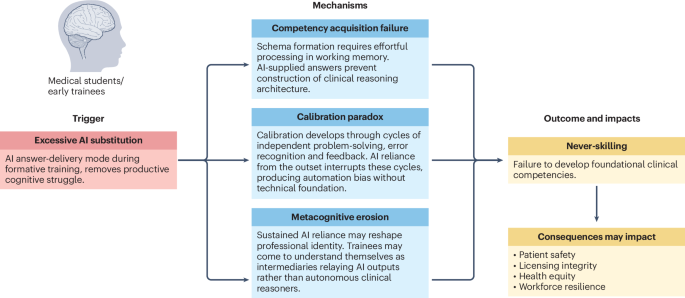
The traditional medical education system has always emphasized the importance of developing critical thinking, problem-solving, and decision-making skills in students. These skills, collectively known as clinical reasoning, enable healthcare professionals to diagnose and manage complex medical cases with ease. However, the rising use of AI in medical education may lead to a “never-skilling” scenario, where medical trainees become over-reliant on AI algorithms and fail to develop these essential skills.
**What This Means**
Imagine a doctor who has never faced a medical emergency without the aid of AI. They may struggle to think on their feet, make sound judgments, and respond to unexpected situations. This could lead to mistakes, delays in diagnosis, and adverse patient outcomes. In essence, the over-reliance on AI in medical education could compromise the development of a vital skillset that is essential for providing high-quality patient care.
**Preserving Foundational Competence**
Researchers **Bajwa, Munir, Nori, and Williams** have proposed a precautionary framework to address the potential risks of AI-induced never-skilling in medical education. Their approach emphasizes the importance of preserving foundational competence, which includes clinical reasoning, problem-solving, and decision-making skills. This framework suggests that AI should be used as a complement to traditional medical education methods, rather than a replacement for them.
**A Balanced Approach**
To strike a balance between AI integration and foundational competence, medical educators can adopt a hybrid approach that combines AI-based learning tools with traditional clinical practice and case-based discussions. This will enable medical trainees to develop essential skills while leveraging the benefits of AI in medical education. By doing so, we can ensure that the next generation of healthcare professionals is equipped to provide high-quality patient care in a world where AI is increasingly prevalent.