
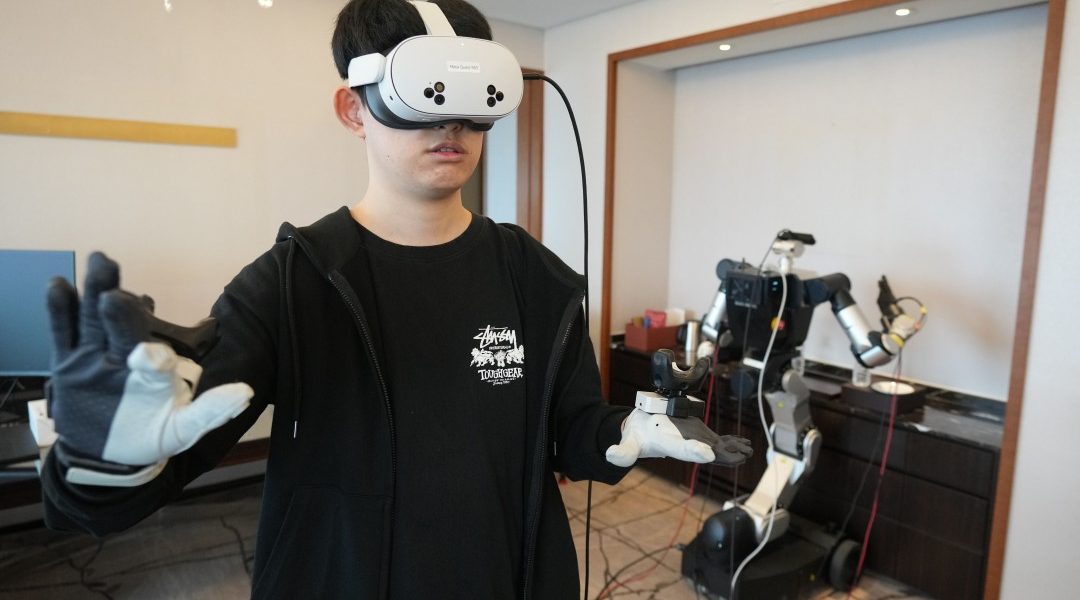
A South Korean startup is capturing the precise movements of hotel staff, with the goal of training AI to replicate their tasks.
**Training AI to Fold Napkins Like a Pro**
David Park, a nine-year veteran of the five-star Lotte Hotel Seoul, was fitted with a peculiar setup: body cameras on his head, chest, and hands. As he deftly folded a banquet napkin, his every move was recorded, feeding into a database that will ultimately teach an artificial intelligence system (AI) to do the same.
The project is led by startup SHINING3D, a company focused on creating AI systems that can understand human movements. They’re using the data from Park’s demonstrations to develop a AI-powered robot that can fold napkins, and potentially, perform other tasks that require precision and dexterity.
**What this means:**
This approach to training AI might just be a small step towards revolutionizing the way we think about tasks that require human-like skills. Imagine having a machine that can fold your clothes, or even help with surgery – the implications are vast.
But for now, SHINING3D is focusing on the more mundane task of napkin folding. They’re not only trying to replicate the physical movements but also the efficiency and speed at which Park can complete the task.
**The AI ‘Brain’**
The team plans to use the data collected from Park’s demonstrations to create a complex neural network. This network will be trained to recognize patterns and understand the relationships between different movements, allowing the AI to learn from the data and eventually perform the task independently.
While this might seem like a trivial task, it highlights the potential for AI to learn from human expertise and adapt to new situations. As the technology advances, we might see more applications in industries like manufacturing, healthcare, and even education.
**A Long Way to Go**
Creating an AI system that can replicate human movements is a complex challenge. It requires not only precise data but also a deep understanding of the underlying mechanics and physics of the task.
SHINING3D’s project is just one example of the innovative approaches being explored in the field of AI. While it’s still early days for this technology, the potential for significant advancements in the coming years is undeniable.
