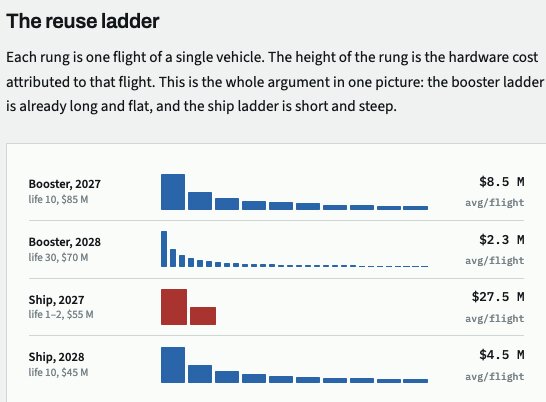
A SpaceX Starship can significantly undercut the cost per kilogram of getting stuff to orbit once it’s managed to fly for at least 10 times, with the final flight of each ship being the cheapest by a factor of up to 2.5 times. A new model from experts suggests that Elon Musk’s reusable rocket system is on the path to achieving the holy grail of space exploration economics.
A Cost-Effective Future
Space is a notoriously expensive frontier, and one of the main reasons is the massive amount of fuel needed to get payloads to orbit. The cost per kilogram is the key metric here, and it’s a major hurdle to overcome if we’re going to see humans (and robots) regularly traveling to space. The Starship model shows that, as the number of flights for both the boosters and the main ship increases, the cost per kilogram falls dramatically.
With the booster flying up to 30 times, the cost per kilogram plummets from $20,000 to just $1,000. Meanwhile, the main ship needs to reach 10 flights to see a similar drop, from $60,000 to $20,000 per kilogram. But here’s the most interesting part: the last flight of each ship is the cheapest of all, with a cost per kilogram that’s up to 2.5 times lower than the first flight.
The Cheapest Flight of All
The researchers behind the model suggest that this is because the last flight of a ship has already absorbed the huge upfront costs of development and production. The initial flights are essentially “loss leaders” – expensive, but necessary to get to a point where the system becomes cost-effective. By the time the final flight comes around, the costs are largely fixed, and the focus is on getting the payload to orbit as cheaply as possible.
This is a major breakthrough for the SpaceX Starship program, which has been plagued by delays and technical issues. But if the model holds true, it could be a game-changer for the future of space exploration. With a cost-effective way to get to orbit, entrepreneurs, scientists, and governments will be able to access space in ways that were previously impossible.
What This Means
The implications of this model are huge. With a reusable rocket system that can undercut the cost per kilogram of getting to orbit, the possibilities for space travel and exploration become almost limitless. It’s no longer just the realm of governments and corporations with deep pockets – space is now within reach of anyone with a good idea and a willingness to take the risk.