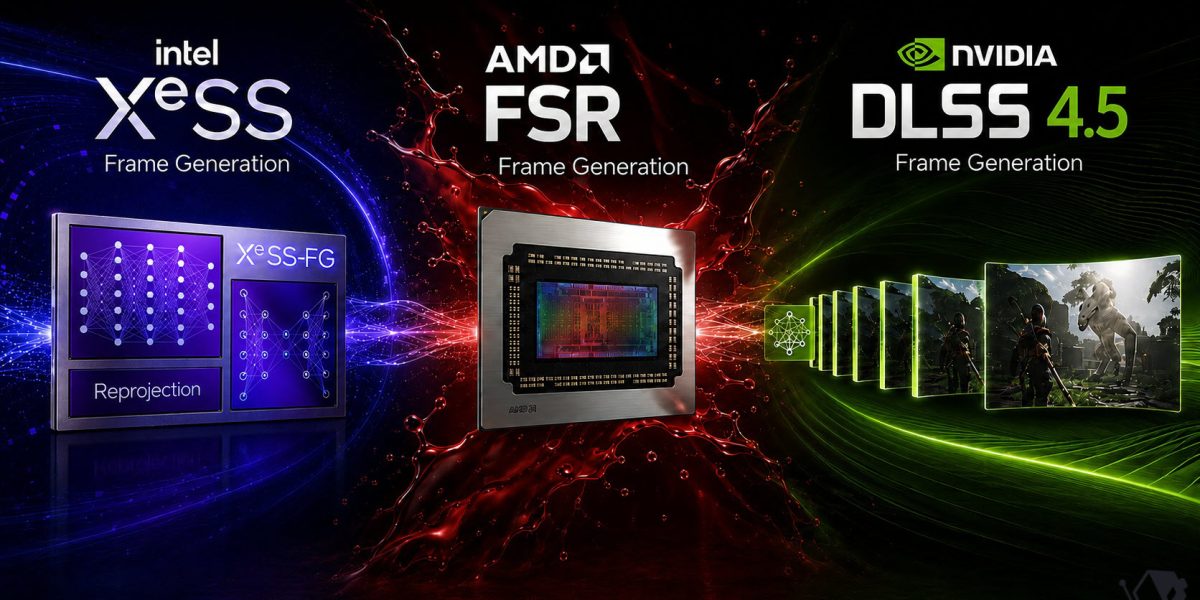

Frame generation is about to revolutionize PC gaming, but you need to know how to use it. NVIDIA recently released its DLSS (Deep Learning Super Sampling) 3.0, while AMD followed suit with its FSR (FidelityFX Super Resolution) 2.1, and Intel has also announced XeSS (Xe Super Sampling), all vying for dominance in this emerging market.
NVIDIA’s DLSS has been the gold standard for frame generation, but AMD’s FSR has gained significant ground, offering a more accessible and affordable solution. Intel’s XeSS, however, is the wild card, promising exceptional performance at the same quality as its competitors.
**What drives the debate?**
The main point of contention revolves around the trade-off between image fidelity and performance. Frame generation technologies use AI to create additional frames between the actual frames rendered by your graphics card, resulting in smoother gameplay and reduced input lag. However, this comes at the cost of image quality, which can sometimes look blurry or artificial.
## Understanding the differences
Each company’s implementation has its strengths and weaknesses. NVIDIA’s DLSS relies heavily on AI to generate high-quality frames, but this requires a significant amount of processing power, which can lead to increased energy consumption. AMD’s FSR, on the other hand, uses a more conservative approach, sacrificing some image quality for better performance. Intel’s XeSS, meanwhile, promises to offer comparable performance to NVIDIA’s DLSS while using less energy.
## What this means
If you’re a gamer, you should be aware of the capabilities of each technology and choose the one that best suits your needs. If you have a powerful GPU and prioritize image quality, NVIDIA’s DLSS might be the best choice. However, if you’re on a budget or looking for a more performance-oriented solution, AMD’s FSR or Intel’s XeSS could be the way to go. **The key is to understand the trade-offs and adjust your expectations accordingly**. Don’t expect all frame generation technologies to produce identical results, but instead, focus on finding the best balance between performance and image quality for your specific setup.
In the end, the competition between these frame generation technologies will drive innovation and push the boundaries of what’s possible in PC gaming. As the market continues to evolve, we can expect to see further refinements and optimizations, leading to even smoother and more immersive gaming experiences.