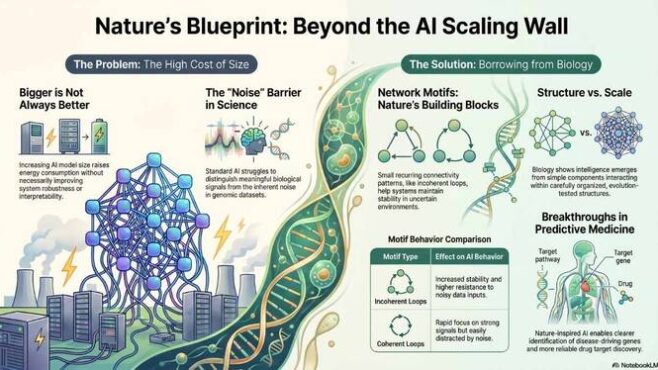
KAUST Study Reveals Biology’s Potential to Redefine AI
A team of researchers at the King Abdullah University of Science and Technology (KAUST) has been studying the intricate patterns found in nature, and they think these patterns could hold the key to the next major breakthrough in artificial intelligence (AI).
The team, led by Dr. **Hajar AlQusayer**, has been analyzing how biological systems process and respond to information, and how these processes might be mirrored in AI systems. They’ve discovered that the patterns and structures found in nature – from the branching of trees to the flow of rivers – have a unique ability to adapt and evolve, which could inspire the development of more efficient and effective AI algorithms.
The researchers have been using techniques like machine learning and computer vision to analyze complex biological systems, such as the way a bird’s feathers branch out or the way a fish swims through the water. By applying these techniques to AI, they’re hoping to create systems that can learn and adapt at a more human-like level.
Nature’s Secrets Could Hold the Key to AI’s Next Breakthrough
According to Dr. AlQusayer, the key to AI’s next breakthrough lies in its ability to understand and replicate the complex patterns and structures found in nature. “Biology has a lot to teach us about how to build more efficient and adaptive systems,” she says. “By studying the way living organisms process and respond to information, we can develop more effective AI algorithms that can learn and adapt at a human-like level.”
The implications of this research are significant, potentially leading to advancements in areas like robotics, healthcare, and finance. For example, more efficient AI algorithms could be used to develop more accurate medical diagnoses or more effective financial models.
What this means for the future of AI
If the KAUST study’s findings are confirmed, they could represent a major shift in the way AI is developed and used. By drawing inspiration from the natural world, researchers may be able to create AI systems that are more efficient, effective, and adaptable. As Dr. AlQusayer notes, “Nature has a lot to teach us about how to build better AI systems.”