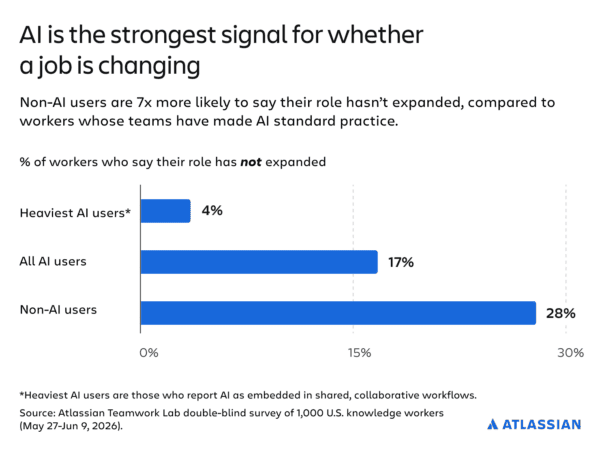
Heavy AI users are 7x more likely to shift from execution to oversight.
Recent research has blown a hole in the conventional wisdom that AI will simply automate jobs, replacing human workers. Instead, heavy AI users are 7x more likely to see their responsibilities evolve from execution to oversight. This means that the same workers who were once bogged down in repetitive tasks are now free to focus on high-level decision-making and strategic planning.
From Doing to Directing
The key finding comes from a study that tracked the impact of AI adoption on professional roles. The data shows that heavy AI users frequently push beyond traditional departmental boundaries, tackling specialized tasks that would normally require external expertise. This shift from hands-on work to high-level oversight is particularly pronounced in technical sectors like engineering and IT.
What this means is that AI is not just augmenting human capabilities – it’s fundamentally changing the nature of work. As AI handles routine tasks, the most capable professionals are rising to the top, taking on more strategic roles that involve guiding projects and making key decisions. This, in turn, opens up new opportunities for growth and innovation within organizations.
The Rise of Hybrid Roles
The research highlights a trend towards hybrid roles that combine technical expertise with high-level business acumen. These professionals are no longer just coding experts or design specialists, but also skilled managers and strategists. They’re able to bring together disparate teams and stakeholders to drive projects forward, often leveraging AI to inform their decisions and optimize outcomes.
The implications of this shift are significant. As AI continues to transform the world of work, organizations will need to rethink their leadership structures and development programs to accommodate this new class of hybrid professionals. By doing so, they’ll be better positioned to drive growth, innovation, and success in an increasingly complex and fast-changing environment.
A New Era of Work
The study’s findings mark a significant turning point in the ongoing conversation about AI’s impact on work. Rather than simply displacing human workers, AI is enabling them to take on more challenging and rewarding roles that demand strategic thinking, creativity, and problem-solving skills. As we move into this new era of work, it’s essential that we adapt our approaches to talent development, leadership, and organizational design to harness the full potential of this technology.