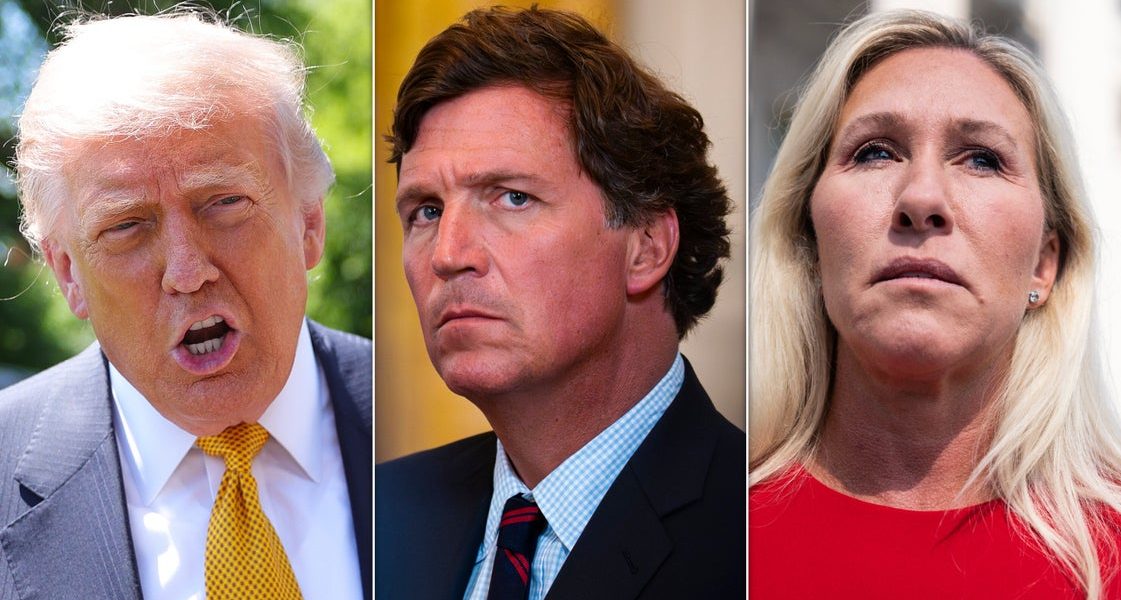
On Saturday, President Donald Trump took aim at several of his right-wing critics using an AI-generated photo on his Truth Social platform.
Targeted Rivals Get Roasted
The attack began with a post targeting Tucker Carlson, the Fox News host who has repeatedly questioned Trump’s claims about the 2020 election. In a photo generated by AI software, Trump’s face was superimposed onto a bodybuilder’s physique, complete with a bold and muscular silhouette. Carlson’s face, on the other hand, was shrunk down to a tiny size, appearing frail and weak in comparison.
But Carlson wasn’t the only one Trump went after. Former congresswoman Marjorie Taylor Greene was also targeted, with Trump’s AI-generated post depicting her face as a cartoonish, exaggerated version of herself. The implication was clear: Trump saw his critics as weak and ineffectual, and he wasn’t afraid to show it.
A New Tool in Trump’s Arsenal
The use of AI-generated photos in Trump’s post was a notable development, marking one of the first times the technology has been used in a high-profile way by a major public figure. The software used to create the images is capable of producing remarkably realistic results, making it a potentially powerful tool for those looking to manipulate public opinion.
But what does this mean for the future of politics? For one, it’s clear that Trump and his team are exploring new ways to use AI for their benefit. Whether that means creating propaganda-style images or using chatbots to spread their message, it’s likely that we’ll see more of this in the coming months.
What This Means for You
The use of AI in politics raises important questions about the role of technology in shaping public discourse. As we become increasingly reliant on AI-generated content, it’s essential to stay vigilant and question the sources of the information we consume. By doing so, we can avoid being manipulated by those who seek to use these technologies for their own gain.