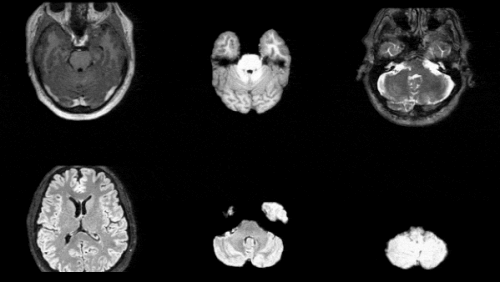
Startup releases AI models that can generate high-quality 3D medical images at scale
A new development in the field of artificial intelligence (AI) has made it possible to synthesize realistic 3D medical images at scale. This breakthrough, announced by a prominent AI startup, aims to address the long-standing challenge of data scarcity, privacy restrictions, and high annotation costs that have hindered the adoption of radiology AI in the past.
Generating High-Quality 3D Medical Images
The startup’s pre-trained models use advanced algorithms to generate photorealistic 3D images of organs, bones, and other body parts. These models are designed to mimic the quality and detail of real medical imaging data, without requiring the costly and time-consuming process of expert annotation.
The technology behind this innovation is based on a combination of generative adversarial networks (GANs) and other AI techniques. By training these models on large datasets, researchers have been able to create synthetic images that are increasingly indistinguishable from real ones.
What this means
With the ability to generate high-quality 3D medical images at scale, healthcare professionals will have access to the data they need to train and deploy more accurate AI models. This could lead to improved diagnosis and treatment outcomes, as well as increased efficiency and reduced costs in medical imaging workflows.
Better Access to Radiology AI
The implications of this development are far-reaching, as it could democratize access to radiology AI for hospitals and clinics around the world. By reducing the barrier of data scarcity and annotation costs, healthcare providers will be able to develop and deploy AI-powered diagnostic tools that can help improve patient care and outcomes.
The startup’s pre-trained models are now available for licensing, and the company is working with leading healthcare institutions to integrate this technology into their clinical workflows. As this technology continues to evolve, we can expect to see even more innovative applications of AI in the field of radiology.