**A Sweet Spot for High-Reasoning AI: OpenAI and Anthropic Make Progress**
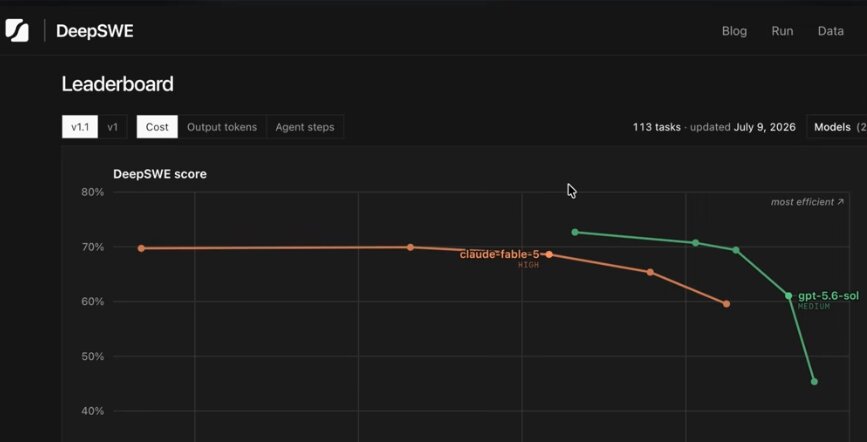
Two of the most promising AI systems in development, OpenAI’s GPT 5.6 and Anthropic’s Fable, have hit a sweet spot in high-reasoning capabilities, according to a recent analysis.
The breakthrough was noticed in a comparison of the two AI systems’ problem-solving abilities, with GPT 5.6 and Fable excelling in tasks that require strong agentic coding and long-horizon planning. This is a significant development, as high-reasoning capabilities are essential for advancing AI research and making these systems more useful in real-world applications.
**A Comparison of Capabilities**
Key highlights from the comparison include:
– GPT 5.6’s strengths in problem-solving, particularly in long-horizon tasks and agentic coding, where it performs significantly better than its predecessor, GPT 5.5.
– Fable’s ability to tackle complex problems with persistence and consistency, showcasing its robust reasoning capabilities.
– The emergence of a ‘sweet spot’ where both systems excel, characterized by high-reasoning tasks and strong agentic coding.
**What this means**
This finding suggests that high-reasoning capabilities are a key area of focus for AI researchers. As these capabilities improve, we can expect to see significant advancements in AI applications, such as:
– **Improved decision-making**: AI systems that can reason effectively will be better equipped to make informed decisions in complex situations.
– **Enhanced problem-solving**: High-reasoning AI will be able to tackle complex problems with greater persistence and consistency, leading to breakthroughs in various fields.
– **More robust AI systems**: As these capabilities mature, AI systems will become more reliable and trustworthy, enabling their adoption in critical areas like healthcare, finance, and education.
The progress in high-reasoning capabilities is an exciting development in AI research, and it will be fascinating to see how these advancements shape the future of AI applications.