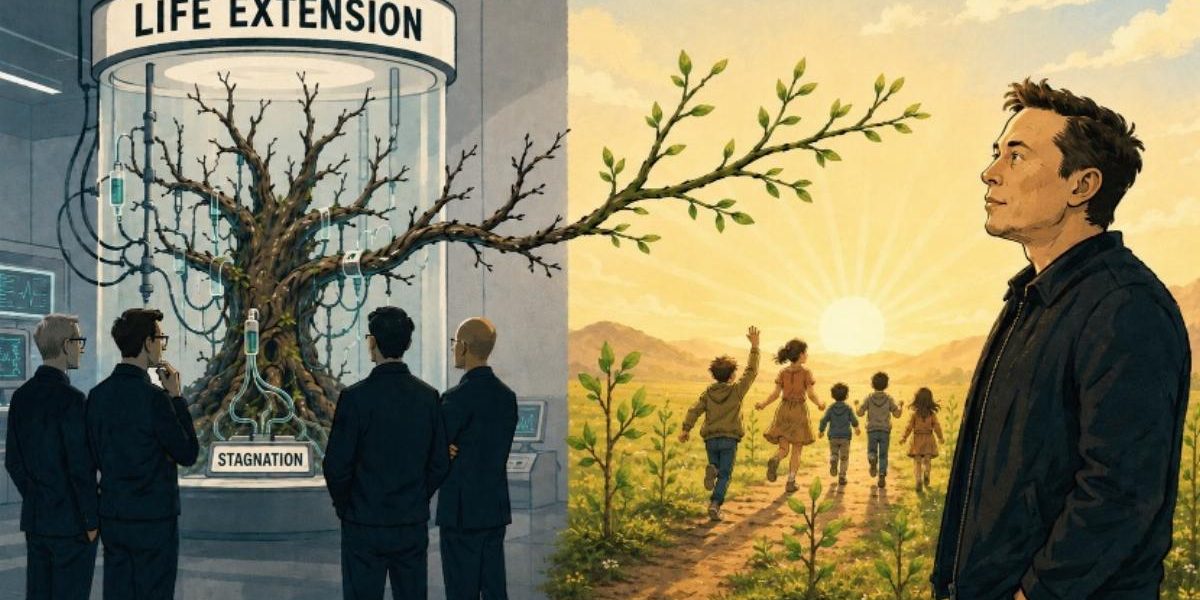
Elon Musk wants to outsmart mortality by merging human and AI brains.
Elon Musk’s Neuralink project has been making waves in the tech world with its ambitious goal of integrating the human brain with AI. But this isn’t just about upgrading human cognition or unlocking new levels of productivity. Musk’s ultimate aim is to defeat death itself.
What drives Musk’s humanist approach?
Unlike other billionaire technocrats, Musk has a strikingly humanist approach. Unlike Peter Thiel, who’s funded life-extension research for years and has spoken openly about transcending mortality, Musk seems more interested in merging our consciousness with AI than just lengthening our lifespan.
Musk believes that as AI continues to advance, humans will eventually become obsolete. He wants to ensure our species’ survival by merging ourselves with AI, effectively creating a new form of life that’s no longer bound by the limitations of a biological body. This vision resonates with Musk’s own existential concerns – he’s been quite open about his desire to have his consciousness preserved even after his own death.
The technical hurdles
Neuralink’s technology involves implanting tiny electrodes into the brain, which can read and write neural signals at a resolution of 1,024 electrodes per centimeter. This raises some mind-boggling possibilities, from treating paralysis and depression to enhancing human cognition and potentially allowing humans to interact directly with AI systems.
While Neuralink is still in its early stages, the implications of this technology are enormous. If it’s successful, we could see a future where human-AI hybrids exist alongside pure AI entities, raising fundamental questions about what it means to be human. What this means for our own mortality is that Musk’s plan could potentially grant us a kind of “digital afterlife” – a way to preserve our consciousness and memories even after our physical bodies cease to function.
As Musk’s vision of the future unfolds, it’s clear that his goal is not just to extend human life but to redefine what it means to be alive. The stakes are high, but one thing’s for sure – this is just the beginning of a fascinating, and potentially life-changing, chapter in the story of human-AI coexistence.