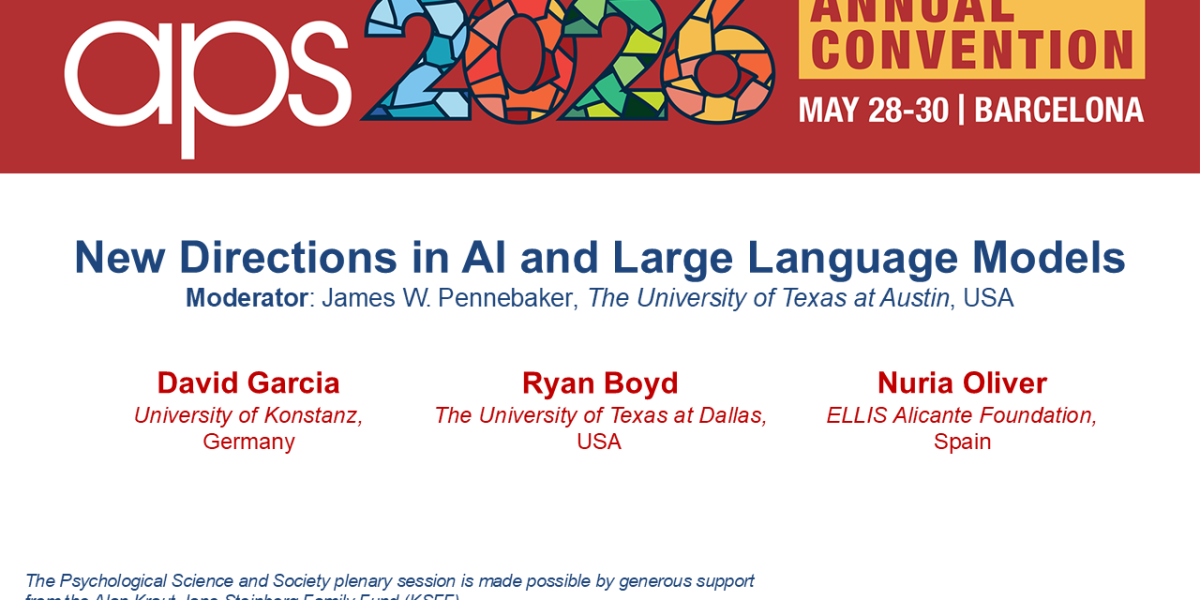
James W. Pennebaker, a renowned psychologist, recently chaired a high-profile panel at the Psychological Science and Society conference, bringing together experts to discuss the implications of artificial intelligence (AI) and large language models (LLMs) on our understanding of the world.
As the AI revolution continues to reshape our scientific landscape, researchers are beginning to explore the boundaries of human knowledge and cognition. At the center of this shift are AI and LLMs, which are fundamentally changing the way we think about statistics, predictions, theories, and our understanding of human behavior.
Expert Insights
The panel, comprised of experts Alex Bentley (The University of Tennessee, Knoxville), Ian Morris (Stanford University), and Stephen Quinn, delved into the complexities of AI and LLMs. These technologies are no longer just tools for automating tasks, but rather sophisticated engines that can generate human-like text, recognize patterns, and even exhibit creative behavior.
According to Ian Morris, LLMs are particularly fascinating because of their capacity to process massive amounts of data, identify relationships between seemingly unrelated concepts, and generate new ideas based on that analysis. This has significant implications for fields such as history, sociology, and psychology, where researchers can now use LLMs to uncover novel insights and patterns that would be difficult to discern manually.
What this means
So, what does this mean for the average person? In practical terms, this shift towards increasingly sophisticated AI and LLMs means that:
* Researchers can now tackle complex problems that were previously too time-consuming or intractable.
* New forms of data-driven storytelling and analysis are emerging, enabling researchers to convey complex ideas in a more engaging and accessible way.
* As AI-generated content becomes more prevalent, we need to consider the implications for authorship, credibility, and trust in the information we consume.
Looking Ahead
As AI and LLMs continue to advance, it’s clear that we’re on the cusp of a new era in scientific discovery and understanding. By embracing these technologies and exploring their implications, we can unlock new possibilities for human knowledge and innovation. However, it’s equally important to acknowledge the challenges and complexities that come with this shift, and to engage in a responsible and informed dialogue about the consequences of our actions.