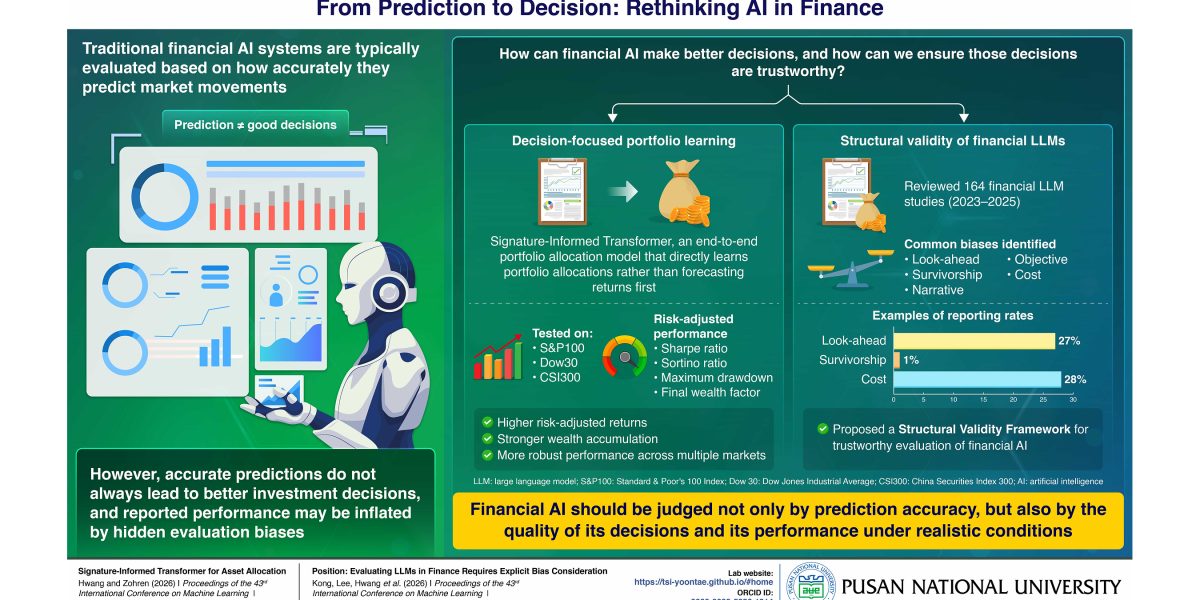
Researchers at Pusan National University have shaken up the investment landscape with a novel AI model designed to provide more accurate financial forecasts.
This new AI model, developed by a team led by Dr. Lee Jong-wook, incorporates a unique combination of machine learning and behavioral finance principles to better predict market trends. According to the researchers, it’s significantly more effective than existing models in capturing complex market dynamics.
The study proposes a comprehensive framework for evaluating the reliability of financial AI systems, which is a major concern in the industry. The framework assesses the robustness of AI models based on their sensitivity to different market scenarios and their ability to adapt to changing conditions.
Traditional AI models often rely on historical data and can fail to anticipate sudden market shifts. In contrast, the Pusan National University model incorporates insights from behavioral finance, which takes into account the psychological biases that influence investor decisions. This approach allows the model to better simulate real-world market behavior.
The researchers tested the AI model on a range of scenarios, including market downturns and periods of high volatility. According to the results, the model consistently outperformed other AI systems in predicting market outcomes.
Implications for Investors and Financial Institutions
The study’s findings have significant implications for investors and financial institutions relying on AI systems for investment decisions. By using a framework to assess the reliability of these systems, investors can make more informed decisions about the risks associated with AI-driven investments.
What this means for investors is that they may need to re-evaluate their reliance on AI systems and consider more nuanced approaches to investment analysis.
A New Era of AI-Powered Investment Analysis
The Pusan National University study marks a significant step forward in the development of AI-powered investment analysis. As the financial industry continues to grapple with the challenges of AI adoption, researchers like Dr. Lee Jong-wook are pushing the boundaries of what’s possible with machine learning and behavioral finance.
The study’s framework and novel AI model have the potential to revolutionize the way investors approach risk assessment and decision-making. By harnessing the power of AI and behavioral finance, investors can make more informed decisions and navigate the complexities of modern finance with greater confidence.