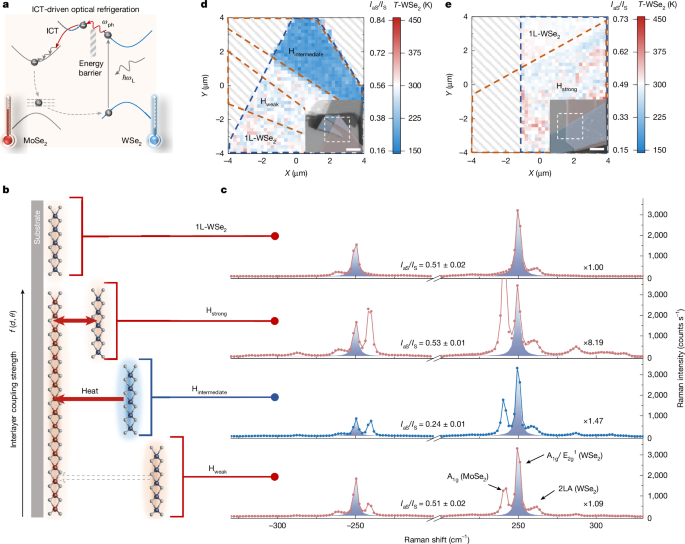
A team of scientists has achieved a major breakthrough in thermal management, harnessing the power of optical cooling in 2D semiconductor heterostructures. Their innovative approach uses phonon-assisted interfacial charge transfer to dissipate heat, potentially paving the way for the development of cryogen-free systems without compromising quantum efficiency.
The Science Behind Optical Cooling
The process involves creating a 2D heterostructure, where two distinct materials are layered on top of each other. Researchers led by **Dr. Pringsheim** have discovered that by manipulating the interfacial charge transfer between these materials, they can facilitate the transfer of heat away from sensitive components using photons.
Phonon-Assisted Interfacial Charge Transfer
This phenomenon, known as phonon-assisted interfacial charge transfer, relies on the exchange of energy between phonons (quantized sound waves) and electrons at the interface between the two materials. By carefully controlling the flow of particles, researchers can create a mechanism for the efficient removal of heat, which is critical for maintaining the performance and stability of various electronic devices.
The potential implications of this research are significant, as it could enable the development of compact, high-performance systems that operate without the need for bulky cryogenic cooling systems. In turn, this could revolutionize applications such as computing, sensing, and communication.
What this means
This breakthrough offers a promising solution to the thermal management challenges facing the electronics industry. If successful, the development of cryogen-free systems could lead to more compact, efficient, and reliable devices, ultimately opening up new avenues for innovation and economic growth.