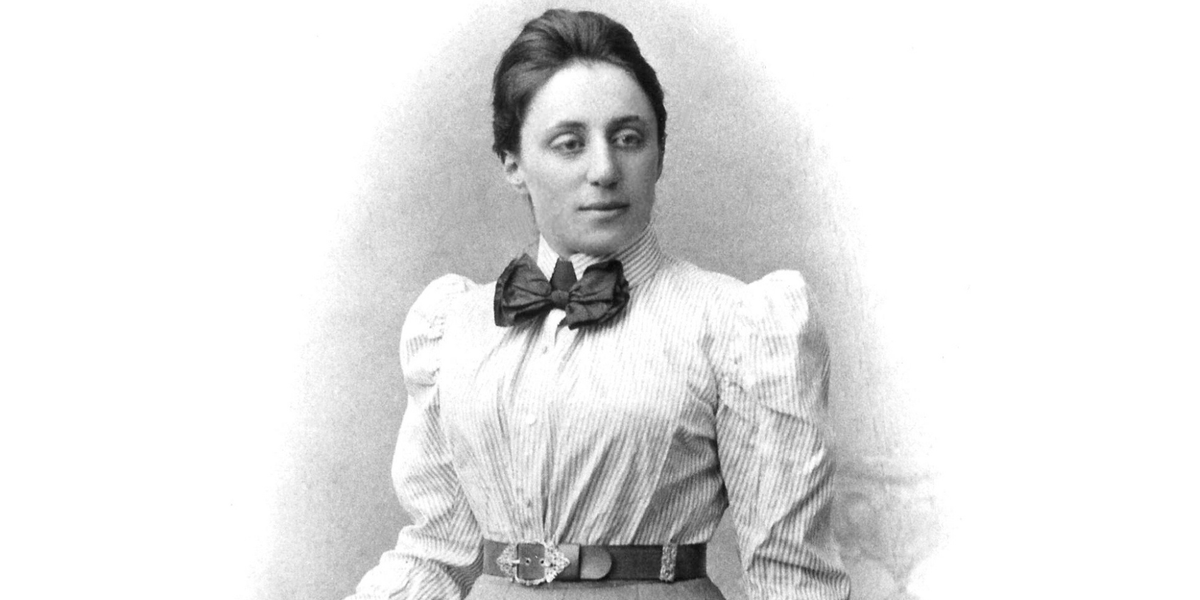
Emmy Noether, a mathematician who died in 1935, has been vindicated by history as one of the most influential thinkers of the 20th century, yet her work was mostly ignored during her lifetime.
Noether’s Theorems
Emmy Noether’s work in the 1910s and 1920s laid the foundation for some of the most fundamental theories in physics. Her Noether’s Theorems, published in 1918, showed that every continuous symmetry in physics corresponds to a conserved quantity – such as energy, momentum, or angular momentum. In other words, if the laws of physics don’t change over time, then energy and momentum must be conserved.
Noether’s Theorems are a cornerstone of modern physics. They helped prove the conservation of energy in physics, a key foundation for Albert Einstein’s theory of relativity. Einstein’s theory, in turn, has had a profound impact on our understanding of space and time.
Einstein’s Debt to Noether
Isaac Newton’s laws of motion, developed in the 17th century, were a major milestone in the development of classical physics. However, Newton’s laws were later shown to be incomplete, as they failed to account for phenomena such as special relativity and gravity. Einstein’s theory of relativity, which posits that the laws of physics are the same everywhere in the universe, resolved many of the paradoxes and inconsistencies in Newton’s work.
Einstein himself acknowledged the importance of Noether’s work, stating that “Noether’s Theorems are the most profound and fruitful theories in modern physics.” Unfortunately, Noether’s contributions were largely overlooked during her lifetime, and it wasn’t until many years after her death that her work gained widespread recognition.
Noether’s Legacy
Today, Noether’s Theorems are a fundamental part of physics education and research. They have been applied to a wide range of fields, from particle physics and cosmology to condensed matter physics and mathematical biology.
Noether’s legacy extends beyond physics, too. Her work has inspired new areas of research in mathematics and computer science, such as computational algebraic geometry and machine learning.
What this means: Noether’s work has far-reaching implications for our understanding of the universe. By recognizing the importance of symmetry and conservation in physics, we can better understand the fundamental laws of nature and develop new technologies to harness their power.