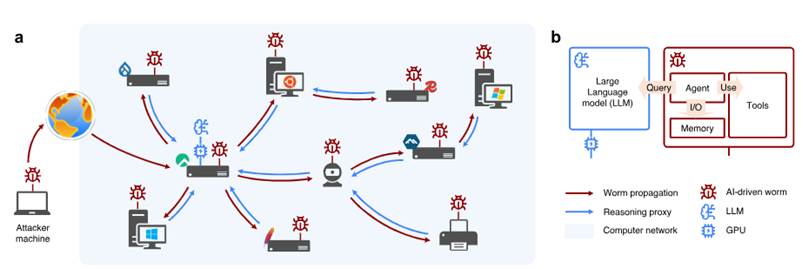
A team of researchers at the University of Toronto has created autonomous malware that can adapt to any online device, dubbed “AI Worms.” The study, published in a recent paper, showcases the capabilities of open-source artificial intelligence in crafting tailored attacks against Windows, Linux, and IoT devices.
Autonomous Malware: A New Threat Landscape
The AI-powered malware, developed by the researchers, uses machine learning algorithms to identify vulnerabilities in various devices and craft personalized attacks. This means that the AI Worms can bypass traditional security measures, making them a significant threat to online security.
According to the researchers, the AI Worms can adapt to different devices by learning from their behavior and exploiting vulnerabilities that were previously unknown. This ability to learn and evolve makes the AI Worms a formidable threat, as they can potentially evade traditional security defenses.
The AI Worms’ Architecture
The researchers designed the AI Worms using a combination of machine learning algorithms and a modular architecture. This allows the malware to learn from its environment, adapt to new situations, and modify its behavior to evade detection.
The AI Worms’ architecture consists of three main components: a neural network for learning and adaptation, a vulnerability scanner for identifying potential targets, and a payload generator for crafting tailored attacks. This modular design enables the AI Worms to be highly effective in a variety of scenarios.
What This Means
The development of AI Worms raises significant concerns about the future of online security. As the AI Worms can adapt to any device, they pose a threat to individuals, businesses, and organizations alike. This highlights the need for more advanced security measures that can keep pace with the evolving threat landscape.
The study serves as a wake-up call for the cybersecurity community, emphasizing the need for new approaches to detecting and preventing AI-powered malware. As AI technology continues to advance, it’s essential to develop strategies that can effectively counter these emerging threats.