Scientists Make Breakthrough in Ultra-Low Voltage Organic Electronics
Researchers at **University of Science and Technology of China** have just published a study that could revolutionize the way we think about displays and electronics. They’ve created a new type of organic light-emitting transistor that operates at an ultralow voltage, making it potentially much more energy-efficient than current displays.
New Technology Paves Way for Stretchable, Wearable Displays
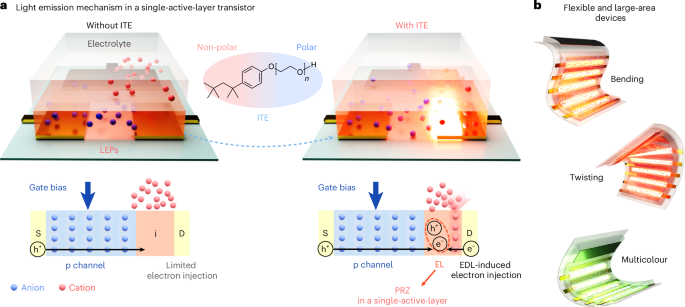
Traditional organic light-emitting transistors require a large operating voltage, which can lead to power consumption issues in devices. They also have a narrow recombination zone, which limits their efficiency. However, a team of scientists led by **Y. Jiang** has discovered a way to overcome these limitations by incorporating an ion transport enhancer into light-emitting polymers.
What This Means
This breakthrough has significant implications for the development of wearable and stretchable electronics. With displays that can operate at such low voltages, we may soon see devices that can be integrated directly into the human body, like implants, contact lenses, or even tattoos. Imagine having a smartwatch that wraps around your wrist, or a display that projects onto your forehead. The possibilities are endless.
Unlocking the Potential of Organic Electronics
The researchers’ discovery is not just a novelty – it’s a game-changer for the field of organic electronics. By making organic transistors more energy-efficient, we can create devices that are not only smaller and more flexible but also more sustainable. This could lead to a new generation of wearables, medical devices, and even consumer electronics that are more affordable, efficient, and environmentally friendly.
What’s Next?
The study’s findings will be a significant focus of research in the coming years. Scientists will be working to refine the technology, improve its efficiency, and explore new applications. As we move forward, we can expect to see more innovative products and devices that take advantage of this groundbreaking research.