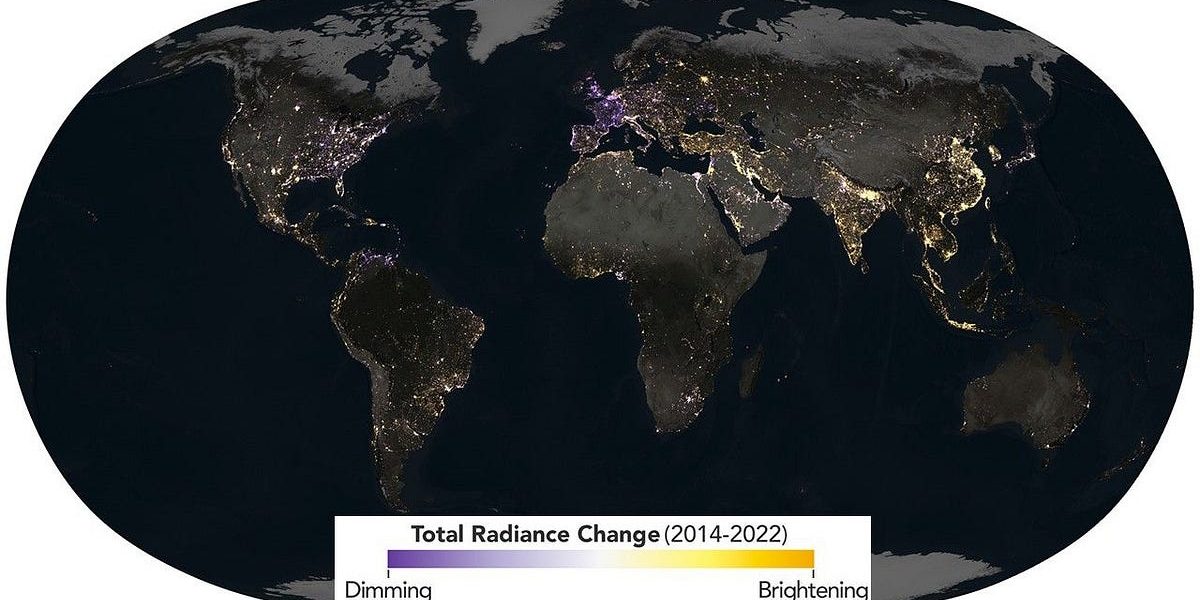
The night sky, once a breathtaking canvas of twinkling stars and celestial wonders, is rapidly vanishing from human sight.
A new analysis of NASA’s Black Marble data has revealed that since 2014, a staggering portion of the Earth’s night sky has been lost due to the proliferation of LED lighting.
The Rise of LEDs
LEDs, or light-emitting diodes, have revolutionized the way we light our homes, streets, and cities. However, their efficiency and affordability have come at a cost. Since their widespread adoption, the night sky has become increasingly polluted, with a significant portion of the Earth’s surface now illuminated by artificial light.
The data from NASA’s Black Marble, a nighttime composite image of the Earth created from satellite imagery, paints a stark picture. From 2014 to 2022, a substantial area of the planet has brightened significantly, with cities and urban areas dominating the map.
The Impact on Humanity
The effects of light pollution on human health and well-being are multifaceted. Research has shown that exposure to artificial light at night can disrupt our circadian rhythms, leading to problems like insomnia, depression, and increased risk of chronic diseases.
Furthermore, the loss of the night sky has a profound impact on our connection to the natural world. Astronomers and stargazers alike are finding it increasingly difficult to access pristine dark skies, hindering scientific research and our ability to appreciate the beauty of the universe.
What This Means
The data is clear: we’re losing the ability to see the night sky as it once was. This isn’t just a matter of aesthetics; it has significant implications for our health, our connection to nature, and our understanding of the universe.
As we continue to harness the power of LEDs and other artificial lighting technologies, it’s essential that we prioritize responsible lighting practices and take steps to mitigate the effects of light pollution. By doing so, we can preserve the night sky for future generations and maintain our connection to the natural world.
LEDs installed since 2014: over 1 billion units worldwide
Area of the Earth affected by light pollution: 80% of the planet’s landmass