
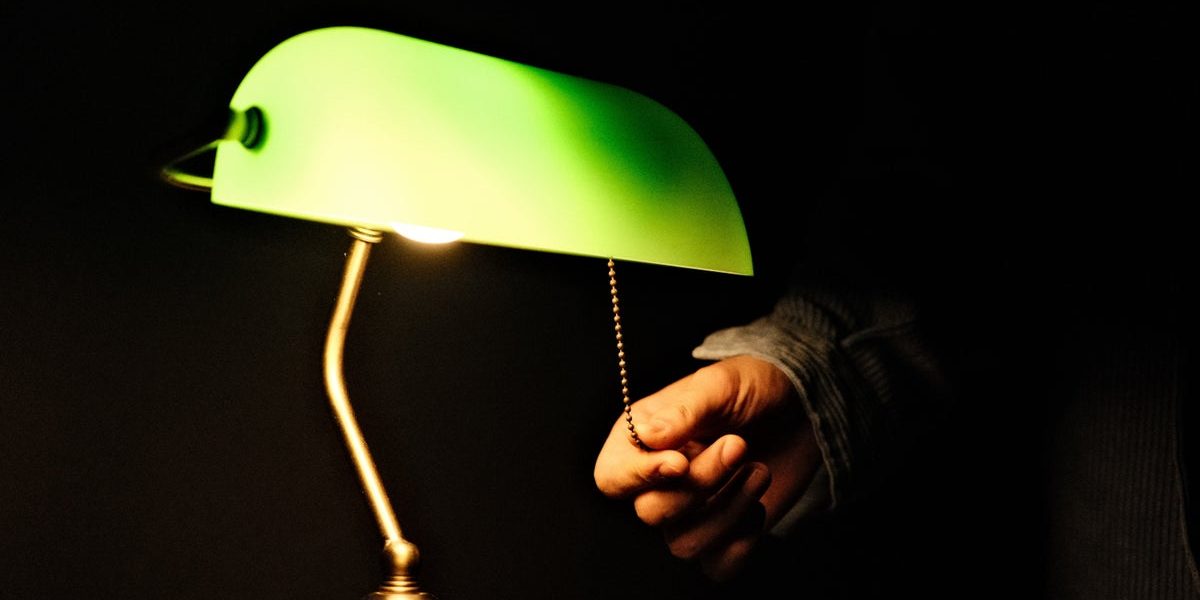
A brilliant problem in mathematics has been inspired by the humble lamp, a staple of homes around the world. Specifically, it’s the scenario of Thomson’s lamp, where a light is switched on and off an infinite number of times: will the lamp ultimately be on or off?
The Math Behind the Mystery
The problem, popularized by mathematician J.J. Thomson in the early 20th century, has puzzled experts for generations. At first glance, one might assume that the lamp would end up in a random state, either on or off. However, the math says that both outcomes are possible – and it’s a paradox that has sparked intense debate in the mathematical community.
The key to solving this problem lies in understanding the concept of infinite sets and the principles of probability. Thomson’s lamp problem is often approached using a thought experiment, where you imagine a mathematician making an infinite number of switches. The math suggests that, given enough switches, the lamp will end up in a state that is both on and off simultaneously.
The Paradoxical Nature of the Problem
The Thomson’s lamp problem highlights the counterintuitive nature of probability theory. In everyday life, we’re accustomed to thinking of probability in terms of chance events, where outcomes are determined by random factors. However, the Thomson’s lamp problem reveals that probability can also be influenced by the infinite, leading to seemingly paradoxical results.
This paradox has implications for our understanding of chance and the nature of reality. If a lamp can be both on and off at the same time, what does that say about the fundamental laws of physics and the behavior of random systems?
What This Means
While the Thomson’s lamp problem may seem like a trivial exercise in mathematics, its implications are far-reaching. It highlights the importance of considering the infinite in probability theory and has sparked new areas of research in mathematical logic and philosophy.
So, the next time you flip a light switch, remember that the math says that, in an infinite number of switches, the lamp could be both on and off – a paradox that continues to fascinate mathematicians and philosophers alike.