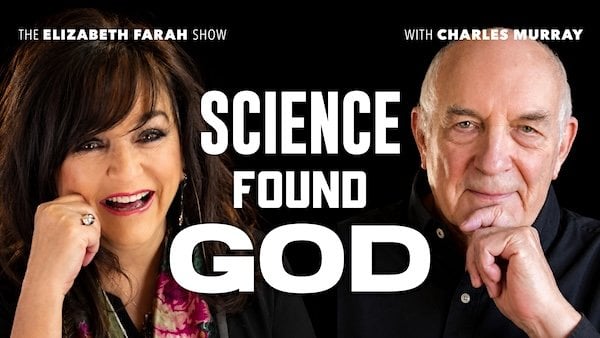
Renowned political scientist Charles Murray has made waves in the intellectual community with his sudden shift in perspective: he now thinks modern science is pointing humanity back toward the concept of God.
Murray, a key figure in the secular intellectual movement, has long been associated with the promotion of materialism and the dismissal of spirituality. But in a candid conversation with Elizabeth Farah, he revealed that recent advancements in science and philosophy have led him to question his earlier views.
A crisis of confidence in materialism
Murray attributes this change of heart to the accumulation of seemingly irreconcilable contradictions within the materialist framework. “The more we learn about the universe, the more it seems to be pointing us in the direction of a deeper, more profound reality that can’t be reduced to mere matter and energy,” he says.
He cites the discovery of complex biological systems that defy explanation by natural processes alone, as well as the strange, seemingly uncaused phenomena observed in quantum mechanics. “These are not just tiny anomalies; they’re fundamental features of the universe that challenge our understanding of reality,” Murray argues.
The problem of ’emergence’
Murray’s concerns revolve around the concept of ’emergence,’ which refers to the phenomenon where complex systems exhibit properties that cannot be predicted from their constituent parts. This, he suggests, is a key area where materialism falters.
“We can’t explain how the human brain, with its 86 billion neurons, gives rise to conscious experience, or how a collection of atoms and molecules suddenly coalesce into a functioning living being,” Murray says. “These emergent properties are a major embarrassment for materialism, and they point to the possibility of a non-material reality.”
What this means: Charles Murray’s conversion may seem surprising, but it reflects a growing unease among some scientists and philosophers about the limitations of materialism. As research continues to push the boundaries of human understanding, it’s possible that the lines between science and spirituality will become increasingly blurred.
A new direction for intellectual inquiry
Murray’s shift in perspective has significant implications for the way we think about the world and our place within it. By acknowledging the limitations of materialism, he’s paving the way for a more nuanced exploration of the human experience.
While some may see this as a retreat from scientific rigor, Murray believes it’s an opportunity to engage with the deepest questions of human existence. “If we’re willing to consider the possibility of a non-material reality, we may find that we’re not as alone in the universe as we thought, and that our existence has a deeper purpose and meaning,” he concludes.