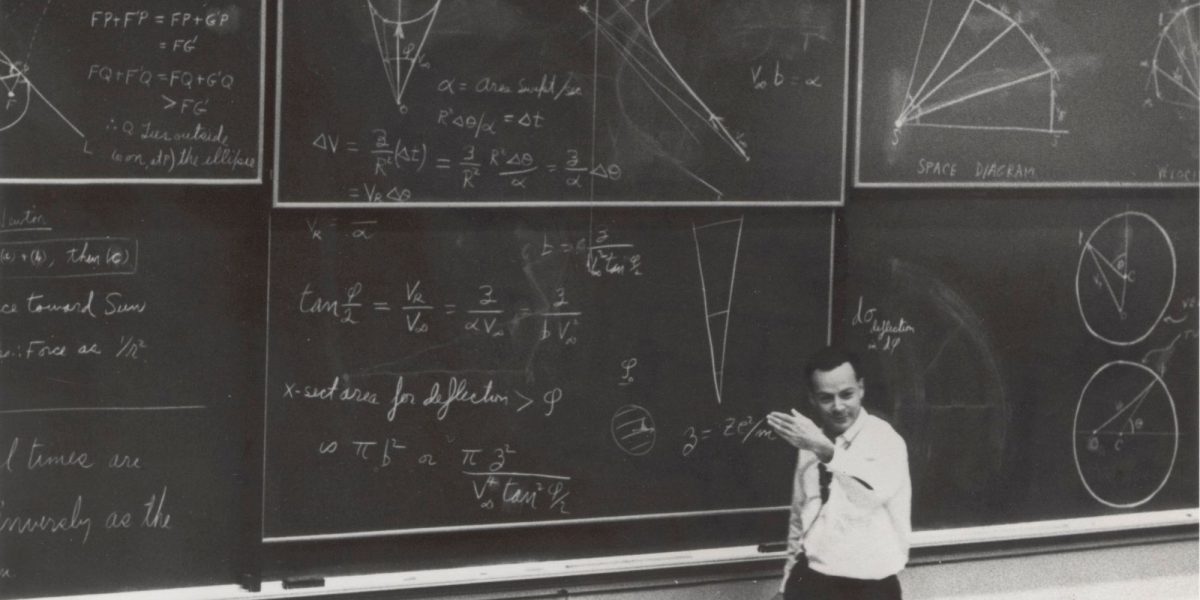
Feynman was fascinated by the Connection Machine, a massively parallel computer designed by Danny Hillis and his team at Thinking Machines Corporation.
The Connection Machine was a radical departure from traditional computers, which process one piece of information at a time. In contrast, the Connection Machine could perform thousands of calculations simultaneously, making it a powerful tool for solving complex problems.
Massively Parallel Processing
Feynman, the legendary physicist and mathematician, saw the potential of the Connection Machine to simulate complex systems and understand the behavior of individual particles. He envisioned a machine that could mimic the behavior of neurons in the human brain, paving the way for groundbreaking advances in artificial intelligence and machine learning.
However, the Connection Machine was ahead of its time, and its commercial success was limited. Despite this, the concept of massively parallel processing has influenced the development of modern computers and has become a fundamental aspect of many AI applications today.
Legacy of the Connection Machine
The Connection Machine may not have achieved mainstream success, but its legacy can be seen in the development of modern computing architectures, including graphics processing units (GPUs) and field-programmable gate arrays (FPGAs). These technologies have enabled rapid advances in AI, deep learning, and machine learning, and have paved the way for applications such as computer vision, natural language processing, and autonomous systems.
What this means
The Connection Machine, although commercially unsuccessful, has had a lasting impact on the development of modern computing and AI. Its legacy can be seen in the widespread adoption of massively parallel processing architectures, which have enabled significant advances in AI and machine learning.
In practical terms, this means that many of the AI applications we use today, such as voice assistants and image recognition algorithms, rely on the principles of massively parallel processing first explored by the Connection Machine.