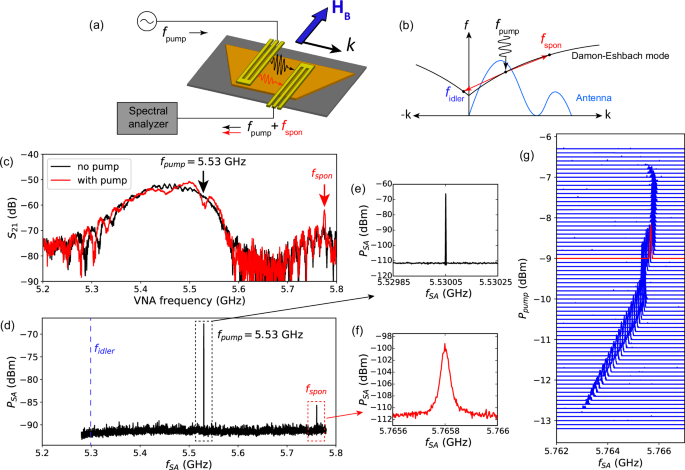
A team of researchers has discovered a way to induce **Magnonic spontaneous oscillation** in a YIG (yttrium iron garnet) thin film using parametric pumping. This process generates **ultrasharp spontaneous spin-wave modes** that behave as **auto-oscillators**, with quality factors exceeding **200,000**. To put that in perspective, a quality factor of 200,000 is incredibly high – it’s like a metronome ticking away with perfect precision for over 14 days without slowing down. This breakthrough has significant implications for the development of next-generation AI and computing technologies.
The discovery is based on the principles of parametric pumping, a technique that involves applying a time-dependent force to a system to induce oscillations. This approach has been studied extensively in the context of electrical oscillators, dating back to the 1940s, when mathematician Richard Adler first described the phenomenon of locking in oscillators. More recently, Japanese mathematician Yoshiki Kuramoto built upon Adler’s work, developing a theory of self-entrainment in coupled non-linear oscillators.
The researchers’ use of parametric pumping to induce Magnonic spontaneous oscillation is a significant departure from traditional methods, which typically rely on thermal excitations or external magnetic fields. By exploiting the unique properties of YIG thin films, the team has created a system that can phase-lock to an external stimulus, opening up new possibilities for synchronization and control in complex systems.
What this means is that scientists may soon be able to develop more efficient and precise AI systems that can learn and adapt in real-time, without the need for expensive and power-hungry computing hardware. The discovery also has potential applications in fields such as quantum computing, where precision timing is crucial for the functioning of quantum gates and other quantum circuits.
What’s next?
The researchers’ findings have sparked excitement in the scientific community, with many experts hailing the discovery as a major breakthrough. As the field of Magnonic technology continues to evolve, we can expect to see further innovations in the application of parametric pumping and the development of new materials and systems that exploit the unique properties of spin waves.