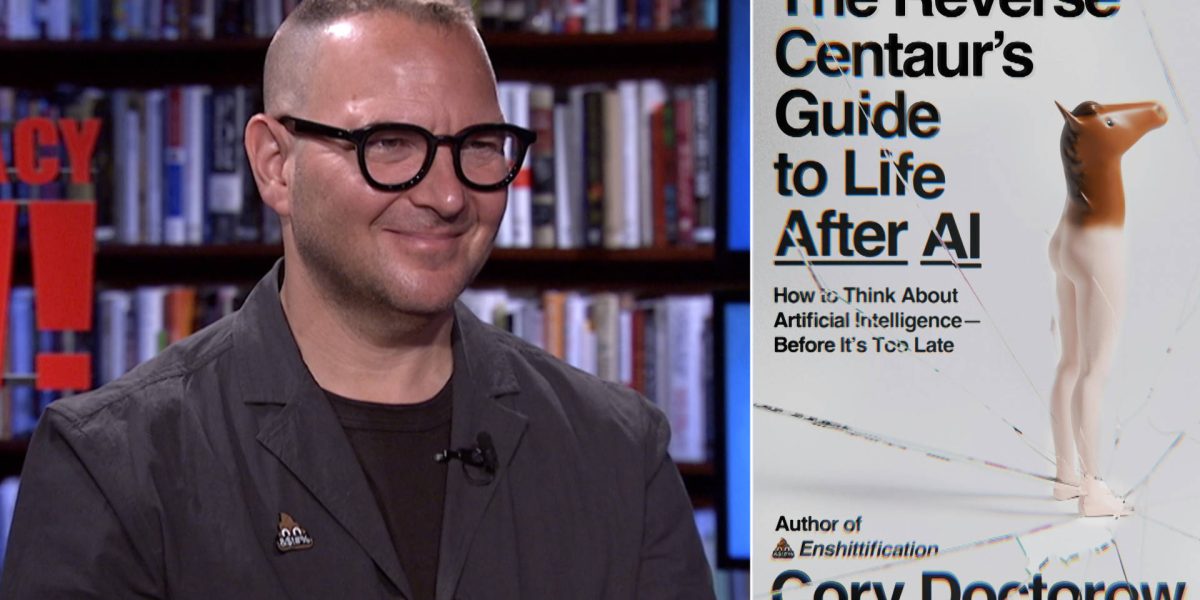
AI has become a ubiquitous presence in our daily lives, with its applications spanning from personalized product recommendations to autonomous vehicles. But beyond the hype, Cory Doctorow, a science fiction author and activist, argues that we’re still struggling to understand the true implications of this technology.
Big Tech’s Influence
“The tech industry is not in the business of serving humanity,” Doctorow stresses. “It’s in the business of serving its shareholders, and it’s going to do whatever it takes to maximize profits.”
This mindset is reflected in the way Big Tech companies have aggressively pursued the development of AI, often with little regard for its consequences. By focusing on the potential benefits of AI, such as increased efficiency and productivity, we risk overlooking its potential downsides, like job displacement and further entrenchment of inequality.
Understanding AI
Doctorow believes that we need to fundamentally rethink our approach to AI, moving beyond simplistic notions of “good” and “bad” and instead focusing on its complex societal implications. “AI is not just a tool that’s going to make our lives easier or more convenient,” he argues. “It’s a fundamental transformation of the world that we live in.”
By examining the intersection of AI, labor automation, and social control, Doctorow’s latest book, The Reverse Centaur’s Guide to Life After AI, aims to provide a more nuanced understanding of this technology and its potential impact on our lives.
The Labor Consequences
As AI continues to displace jobs across various industries, Doctorow warns that we’re sleepwalking into a future where many people are left behind. “We’re already seeing the automation of entire sectors, from manufacturing to transportation to customer service,” he notes. “And we’re not doing anything to prepare for the consequences of that.”
What this means is that we need to start thinking about a world where work is no longer the primary source of income or identity. By exploring alternative forms of social organization and economic distribution, we can create a more equitable society that’s better equipped to handle the challenges posed by AI.