**Astonishingly Affordable Spacecraft: Starfall’s Bill of Materials Revealed**
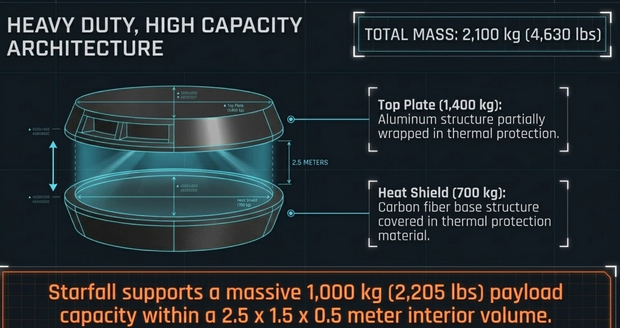
A recent update has provided a sneak peek into the design decisions behind **Starfall**, the latest orbital launch vehicle from a prominent space company. With a dry mass of **2.1 tons**, Starfall is a fraction of the size of its competitors, such as the Starship upper stage, which clocks in at around 85-100 tons.
At just **1/40th** the size of the Starship upper stage, Starfall’s simplified systems – including no main propulsion and no parachute landing system – have made it an incredibly cost-effective option for mass production, much like the Starlink satellite constellation. This mass-production approach is key to the design of Starfall, and it’s expected to result in significantly reduced costs as production scales up.
Unit Costs Plummet with Volume
The **Bill of Materials (BOM)** for Starfall reveals the company’s emphasis on efficiency and affordability. By minimizing the complexity of its systems and focusing on mass production, the company aims to drive down unit costs and make orbital launches a more accessible option for a wider range of customers. With Starfall, the company is targeting a market where the cost of access to space is a significant barrier to entry.
A New Era of Space Access?
The implications of Starfall’s design and production approach are significant. If successful, it could pave the way for more frequent and affordable orbital launches, opening up new opportunities for scientific research, satellite deployments, and even space tourism. As the space industry continues to evolve, projects like Starfall are pushing the boundaries of what’s possible and helping to make space more accessible to everyone.
What this means
For space enthusiasts and industry insiders, Starfall’s BOM and cost estimate offer a glimpse into the future of space access. The project’s focus on affordability and mass production could lead to a new era of frequent and affordable orbital launches, making space exploration more accessible to individuals and organizations around the world.