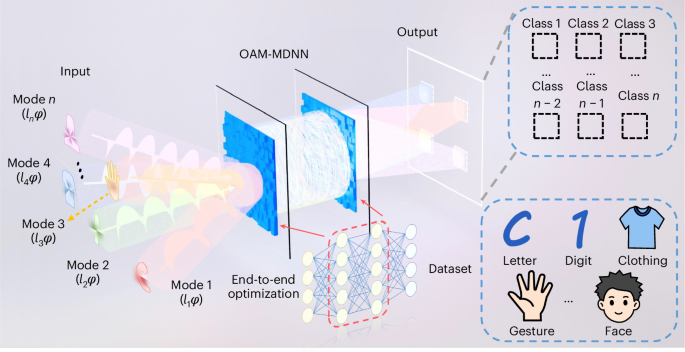
A team of researchers has created a deep diffractive neural network that boosts optical inference capacity by 14 times, enabling the recognition of 100 object categories in a single task. The breakthrough relies on optical angular momentum multiplexing and an auto-optimization strategy, pushing the boundaries of what’s possible in neural network design.
The Science Behind the Breakthrough
Traditional neural networks process information in a linear fashion, whereas diffractive neural networks exploit the complex interactions between light waves to achieve greater efficiency. In their new approach, Veerabadran et al. drew inspiration from the way light behaves in the real world, leveraging optical angular momentum to multiplex multiple tasks within a single network. This allowed them to significantly increase the network’s capacity.
Auto-optimization and the Future of Neural Networks
The researchers implemented an end-to-end auto-optimization strategy to fine-tune the network’s performance. This approach automated the labor-intensive process of manually encoding the neural network’s parameters, freeing up time for more complex tasks. By doing so, they achieved an unprecedented 14-fold increase in mode utilization – a metric that measures the network’s ability to process information.
Implications for AI and Beyond
The success of this research has far-reaching implications for the development of more efficient and capable neural networks. By pushing the limits of what’s possible in neural network design, the team has paved the way for future breakthroughs in areas such as computer vision, natural language processing, and even quantum computing. What this means for everyday users is that we can expect to see more sophisticated AI-powered systems that can handle complex tasks with greater precision and speed.
The Next Frontier: Multitasking in AI
This study’s focus on multitasking neural networks opens up exciting possibilities for future research. As AI systems become increasingly adept at handling multiple tasks simultaneously, we can expect to see significant advancements in areas like robotics, healthcare, and finance. The potential applications of this technology are vast, and the researchers’ work is a crucial step toward making these possibilities a reality.