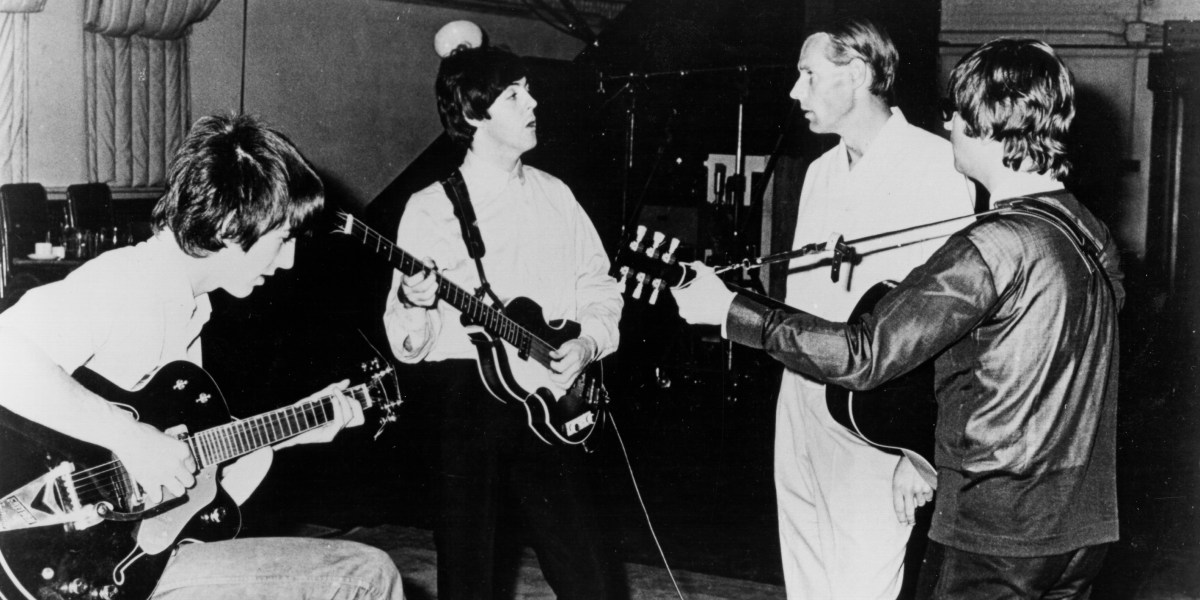
George Martin wasn’t a better songwriter than the Beatles, but his unique role as their producer helped him hear possibilities they couldn’t.
The “Fifth Beatle” and the Dean of Innovation
George Martin’s leadership in the recording studio was instrumental to the Beatles’ success, but it wasn’t because he had better songwriting skills than Paul McCartney and John Lennon. It’s because, as a producer, Martin’s job was to hear the song’s potential, not to out-write the songwriters. This difference in perspective is a crucial lesson in leadership, one that’s just as relevant today as it was in the 1960s.
In 1965, Paul McCartney brought Martin a new song called Yesterday. McCartney asked Martin what the song needed, and Martin’s response was unconventional. He envisioned a string quartet on a Beatles rock record, something no one in the Beatles’ circle had considered before. Martin didn’t have a better answer than McCartney, but he heard a possibility that McCartney, as a songwriter, had overlooked.
This ability to hear new possibilities, to see beyond the limitations of their own thinking, is a hallmark of effective leaders. It’s not about having all the answers, but about asking the right questions and encouraging others to think creatively. In the AI era, where complexity and uncertainty are the norm, this kind of leadership is more important than ever.
What this means
AI and machine learning are not just about writing code or collecting data. They’re about collaboration, creativity, and innovation. To succeed in this field, leaders need to foster an environment where people are encouraged to think outside the box, to hear possibilities that no one else has considered. By embracing Martin’s approach to leadership, we can unlock new possibilities in AI and beyond.