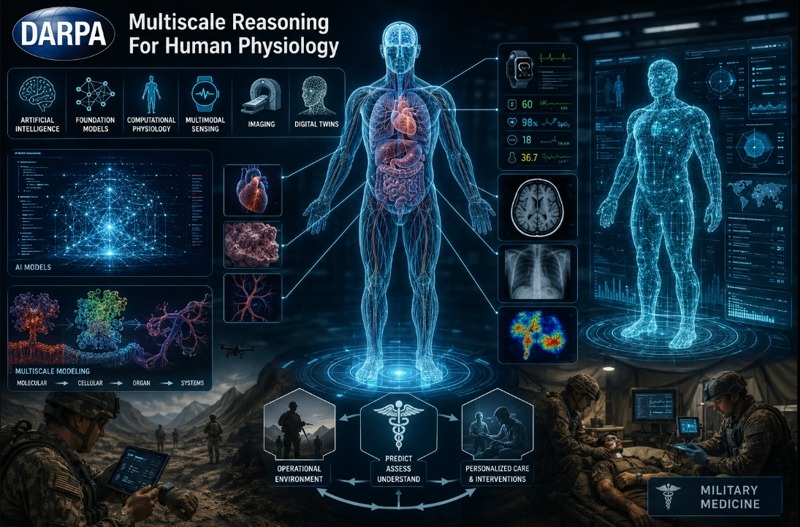
**DARPA Unveils Ambitious Plan to Model Human Health at Every Scale**
The US Defense Advanced Research Projects Agency (DARPA) has launched a bold initiative to develop a comprehensive model of human health, biology, and physiology, with a focus on advancing military medicine.
**The Program’s Goals**
The goal of DARPA’s **Multiscale Reasoning for Human Physiology** program is to integrate knowledge from various disciplines, including biology, physics, and mathematics, to create a predictive model of human health. This model will be able to account for biological processes at different scales, from the molecular level to the organism as a whole. Researchers will use a combination of machine learning, artificial intelligence, and high-performance computing to integrate data from various sources, including medical imaging, genomics, and electronic health records.
**Why This Matters**
While the program is primarily focused on improving military medicine, the potential benefits for civilian healthcare are significant. A comprehensive model of human health could lead to better diagnosis and treatment of diseases, as well as more effective prevention strategies. It could also enable personalized medicine, where treatment plans are tailored to an individual’s specific biology and health status.
**What This Means**
This means that patients may eventually receive more targeted and effective treatments, and that healthcare providers may be able to identify and address health issues earlier, potentially reducing the risk of costly and debilitating illnesses.
**A Long-Term Vision**
DARPA’s Director, **Dr. Kari Bremner**, has stated that the ultimate goal of the program is to create a “digital twin” of the human body, a virtual replica that can be used to simulate and predict the effects of different treatments and interventions. While this vision may seem ambitious, it has the potential to revolutionize healthcare and improve outcomes for patients around the world.
The success of DARPA’s **Multiscale Reasoning for Human Physiology** program will depend on the ability of researchers to integrate complex data from various sources and to develop effective machine learning algorithms that can handle the intricacies of human biology. If successful, however, this program could have a lasting impact on healthcare and medicine.