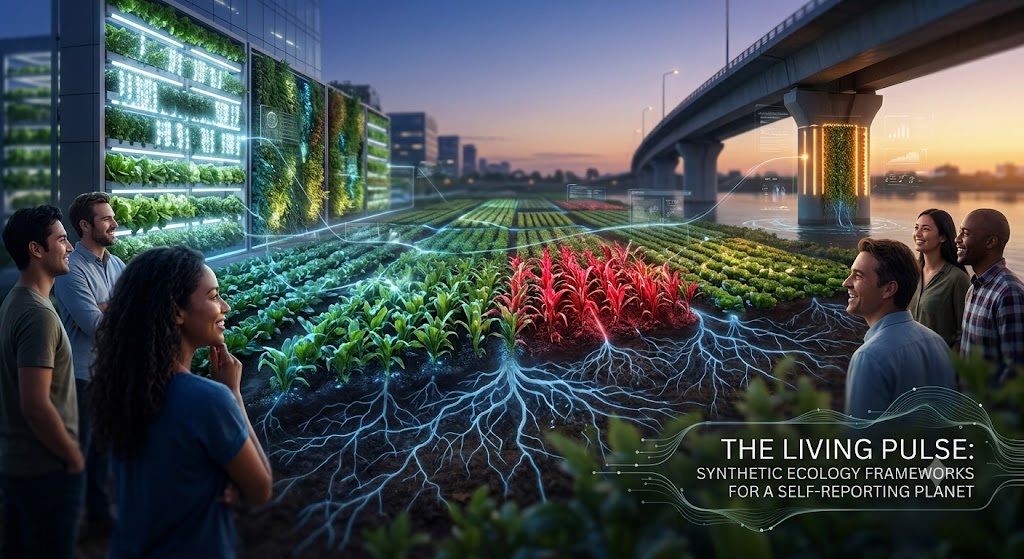
**A Planet That Speaks Up: AI-Driven Synthetic Ecology Frameworks**
The concept of a self-reporting planet is no longer science fiction, thanks to the innovative work of researchers at Art Inteligencia. Their latest project, Designing Synthetic Ecology Frameworks for a Self-Reporting Planet, aims to revolutionize the way we monitor and manage complex ecosystems.
Imagine a future where buildings, crops, and infrastructure communicate their vital signs in real-time, providing early warnings of potential failures. This is the vision behind synthetic ecology frameworks, an AI-driven approach that seeks to turn the built environment into a vast network of self-reporting sensors.
The current systems we rely on, such as agricultural supply chains, corporate real estate, and urban grids, are “silent” until they fail. This lack of visibility makes it difficult to identify and mitigate risks before they become catastrophic. By contrast, synthetic ecology frameworks would allow for continuous monitoring and analysis of these systems, enabling proactive decision-making and minimizing the risk of disaster.
How it works: The framework is based on a complex network of interconnected nodes, each representing a component of the system (e.g., a building, a crop, or a water treatment plant). These nodes are equipped with sensors that collect data on temperature, humidity, energy consumption, and other relevant factors. AI algorithms then analyze this data to identify patterns and anomalies, providing an early warning system for potential problems.
The benefits of synthetic ecology frameworks are twofold. On the one hand, they would enable more efficient use of resources by predicting and preventing waste. On the other hand, they would allow for more effective disaster response by providing critical information in the event of an emergency.
**What this means**: A self-reporting planet would be a much more resilient and sustainable place. With synthetic ecology frameworks, cities, industries, and communities would be able to anticipate and mitigate risks, reducing the likelihood of catastrophic failures and minimizing the impact of natural disasters. This is not just a futuristic vision – it’s a tangible step towards a more intelligent and responsive built environment.