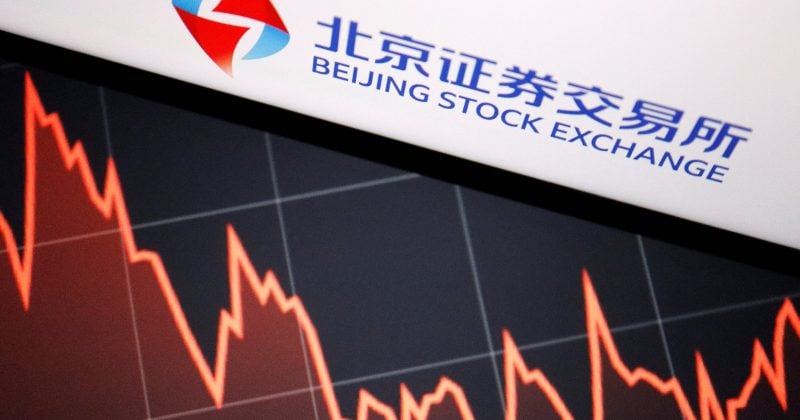
A global chip stock selloff has left China’s quantitative hedge funds reeling, exposing their crowded positions and momentum traps. High-Flyer’s fund dropped a staggering 15.7% in a single week, marking a severe blow to the country’s fast-growing quant industry.
Quantitative Hedge Funds on Thin Ice
Quantitative hedge funds use complex algorithms and machine learning models to make investment decisions. They rely heavily on AI to identify patterns and make predictions about market trends. However, this reliance on AI can also make them vulnerable to momentum traps and over-trading. When the market suddenly turns against them, their AI-driven strategies can lead to steep losses.
China’s quant industry has been growing rapidly in recent years, with many funds attracting large amounts of capital from investors looking for high returns. However, this growth has also led to a crowded market with many funds competing for the same investments. When the global chip selloff occurred, it exposed the crowded positions and momentum traps within the industry.
The AI Problem
The use of AI in quantitative hedge funds is a double-edged sword. On the one hand, AI can analyze vast amounts of data and make predictions with a high degree of accuracy. However, AI is only as good as the data it is trained on, and it can be vulnerable to biases and errors. When AI-driven strategies go wrong, they can lead to catastrophic losses.
High-Flyer’s fund, which lost 15.7% in a single week, is a prime example of this. The fund’s AI-driven strategy was designed to take advantage of market momentum, buying stocks that were on the rise and selling those that were falling. However, when the global chip selloff occurred, the fund’s AI-driven strategy led to a series of disastrous trades.
What This Means
The losses suffered by China’s quantitative hedge funds are a stark reminder of the risks associated with AI-driven investment strategies. While AI can be a powerful tool for making investment decisions, it is not a silver bullet. Investors need to be aware of the potential risks and take steps to mitigate them. This includes diversifying their portfolios and setting stop-loss orders to limit potential losses.