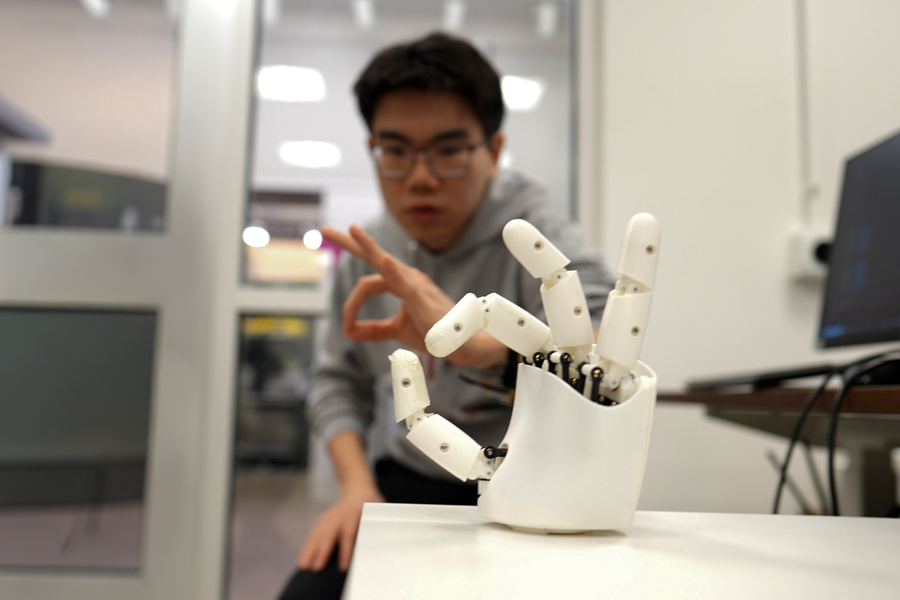
Researchers have developed a wristband that enables wearers to control a robotic hand with their own movements, potentially paving the way for more intuitive and natural human-robot interactions.
Control with a Flick of the Wrist
By moving their hands and fingers, users can direct a robot to play piano or shoot a basketball, or they can manipulate objects in a virtual environment. The wristband, developed by a team of researchers led by Dian Li, a graduate student, uses electromyography (EMG) sensors to detect the electrical signals generated by the wearer’s muscles.
These signals are then translated into instructions for the robotic hand, allowing the user to control it with remarkable precision. In a demo, Li showed how the wristband enabled her to play a piano melody with the robotic hand, complete with nuanced dynamics and expression.
Advancements in Human-Robot Interaction
The wristband’s success represents a significant step forward in human-robot interaction, which has been a long-standing challenge in robotics development. Current methods of control, such as joysticks or gesture recognition systems, can be clumsy and impractical, limiting the robot’s potential uses.
The wristband’s EMG sensors offer a more natural and intuitive way to interact with robots, potentially opening up new possibilities in fields like healthcare, manufacturing, and education. For example, patients with mobility impairments could use the wristband to control robotic assistants that help with daily tasks.
What this means
The wristband’s technology has the potential to make robots more accessible and user-friendly, allowing people to interact with them in a more natural and intuitive way. While the technology is still in its early stages, it’s an exciting development that could lead to new applications and innovations in the field of robotics.
The researchers’ next steps will involve refining the wristband’s algorithms and testing its capabilities in more complex scenarios. As the technology advances, we can expect to see more sophisticated human-robot interactions that blur the lines between humans and machines.