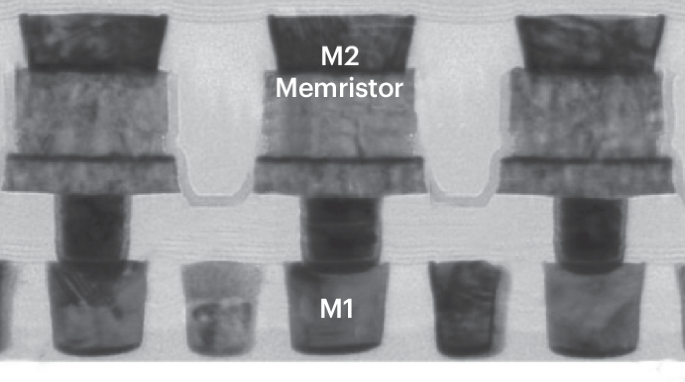
A team of researchers at Stanford University has made a significant breakthrough in the development of high-precision computing using memristors.
Memristors: The Resistive Revolution
Memristors, short for memory resistors, are two-terminal devices that can store data and perform calculations. They’re essentially resistors with memory, allowing them to adapt their resistance levels based on the electric current flowing through them.
Imagine a switch that remembers whether it’s been turned on or off. Memristors work similarly, but with resistive properties. This unique characteristic makes them highly promising for AI applications, where complex calculations and adaptive learning are essential.
The Challenge of Inherent Properties
However, memristors have a significant drawback: their inherent properties can lead to inaccuracies in computing. These properties arise from the device’s manufacturing process, temperature variations, and other factors that can affect the memristor’s resistance levels.
The Stanford University team, led by researchers Dr. Wei Lu and Dr. Shyue Ping Ong, has been working to understand and mitigate these inherent properties. By studying the memristor’s behavior at various levels – device, array, and system – they’ve developed new design strategies to achieve accurate computing.
Coordinated Design for High-Precision Computing
The researchers used a combination of experimental and theoretical approaches to understand the memristor’s behavior under different conditions. They discovered that coordinating device-level properties with array-level design and system-level optimization can significantly improve accuracy.
This breakthrough has significant implications for AI applications that require high-precision computing, such as neural networks. By leveraging memristors’ adaptive properties, AI systems can learn and adapt more efficiently, leading to improved performance and efficiency.
What this means: This research brings us closer to developing more efficient and accurate AI systems. With memristors, we can create neural networks that learn and adapt faster, paving the way for breakthroughs in applications like edge AI, IoT, and predictive maintenance.