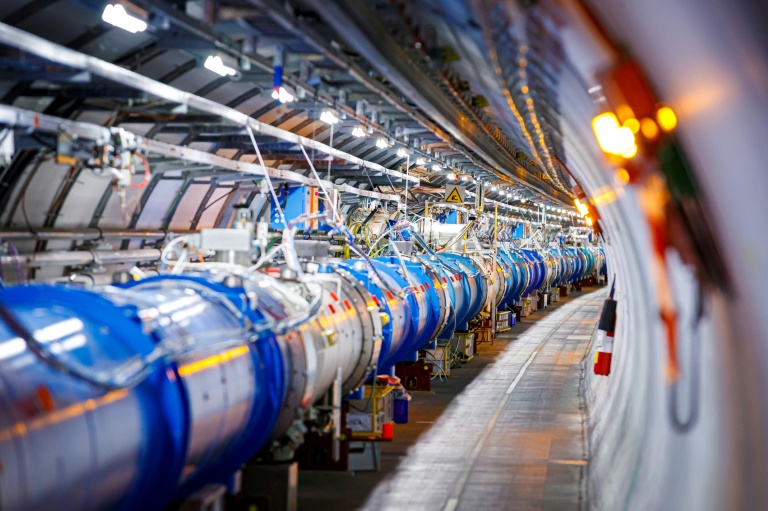
The Large Hadron Collider (LHC) will finally come to a stop this Monday, signaling the beginning of a four-year shutdown to undergo a major upgrade aimed at revolutionizing its collision capacity and potentially uncovering the secrets of dark matter.
A Dark Matter Hunt Like Never Before
The LHC, operated by CERN, has been smashing particles together since 2008, helping scientists discover the Higgs boson in 2012 and pushing the boundaries of our understanding of the universe. But despite its impressive track record, the LHC’s current limitations are hindering its ability to detect dark matter, a mysterious substance that makes up approximately 27% of the universe’s mass-energy density. The upgrade, scheduled to be completed by 2027, promises to change that.
Boosting Collision Capacity
The LHC’s current design allows for collisions to occur at a rate of around 40 megahertz, which is fast but not fast enough to detect the faint signals of dark matter particles. The upgrade, which includes the installation of new detectors and a more powerful magnet system, will increase the collision rate to a staggering 1.3 gigahertz. This boost in collision capacity will give scientists a much better chance of detecting the tiny signals produced by dark matter particles.
But the upgrade is more than just a technical tweak; it’s a strategic shift in the global hunt for dark matter. The LHC’s focus on high-energy collisions has led to some remarkable discoveries, but it’s also limited its ability to detect dark matter, which is thought to be composed of weakly interacting massive particles (WIMPs). The new detectors and magnet system will allow scientists to probe the universe in a way that’s never been possible before.
The Hunt for Dark Matter Heats Up
The upgrade marks a significant milestone in the global effort to understand dark matter, a mystery that has puzzled scientists for decades. If successful, the LHC’s new capabilities could lead to a major breakthrough in our understanding of the universe, opening up new avenues of research and potentially shedding light on some of the biggest questions in modern physics.
What this means: The upgrade will give scientists a better chance of detecting dark matter particles, potentially leading to a major breakthrough in our understanding of the universe.