AI Scientists Crack Neural Code, Unveil Secrets of Learning and Adaptation
New research published by scientists at [**strong**] MIT[/strong] reveals a fundamental shift in our understanding of how the brain learns and adapts to new information. By analyzing the neural geometry of the prefrontal cortex in primates, researchers have identified a clear pattern of transformation that occurs as learning takes place.
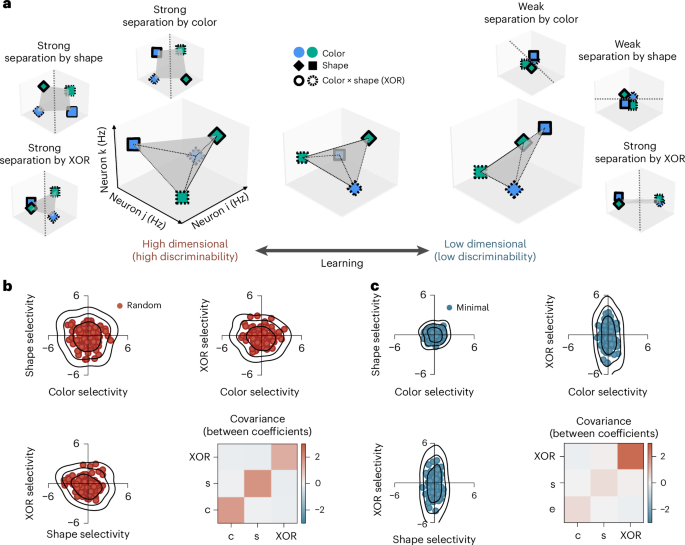
The prefrontal cortex, known for its role in decision-making and problem-solving, initially represents information in a flexible, high-dimensional way.
However, as learning progresses, this representation becomes more compact, task-relevant, and abstract, allowing for efficient generalization of learned rules to new stimuli and contexts. This means that the brain is able to distill complex information down to its essence, enabling it to apply what it has learned to a wider range of situations.
A Key to Efficient Learning
The researchers used generative models to study the non-linear dynamics of neural activity in the prefrontal cortex. They discovered that the geometry of neural representations undergoes a significant transformation during learning, moving from random and minimal selectivity to a more organized and abstract code.
What this means
This breakthrough has significant implications for our understanding of how the brain learns and adapts. By identifying the neural mechanisms that underlie efficient learning, researchers can develop more effective strategies for training artificial intelligence systems that mimic human learning.
A New Frontier for AI Research
The findings of this study open up new avenues for research into the neural code, a long-sought but still-elusive understanding of how the brain represents and processes information. By studying the dynamic geometry of neural representations, scientists can gain a deeper understanding of how the brain learns and adapts, and develop more sophisticated AI systems that can learn and generalize in a more human-like way.
As AI continues to evolve and improve, understanding the neural code will be crucial for developing systems that can learn and adapt in complex, dynamically changing environments.
The study’s findings have far-reaching implications for fields such as neuroscience, cognitive psychology, and artificial intelligence, and are likely to inspire new research and innovation in these areas.