
**Scientists Unleash AI-Powered Optical Tweezers to Revolutionize Biophysics Research**
Researchers have just unveiled SmartTrap, a cutting-edge platform that automates precision experiments using optical tweezers, allowing scientists to study the intricate mechanics of molecules and cells with unprecedented accuracy and minimal human intervention.
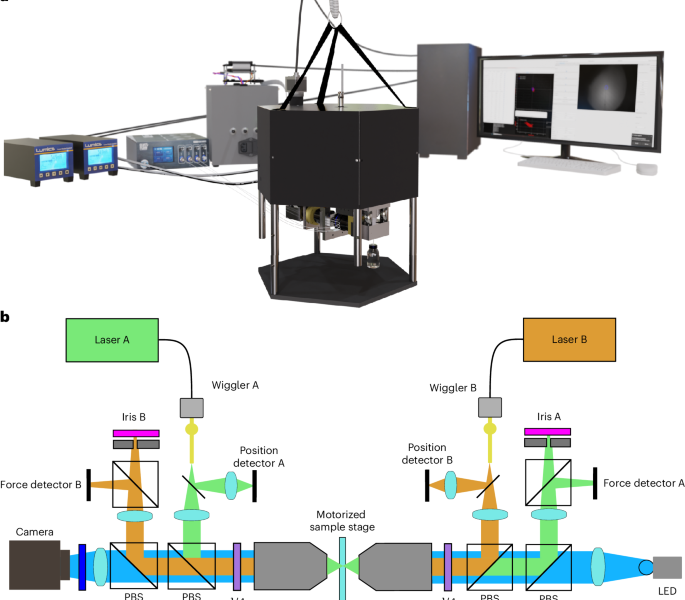
SmartTrap’s innovative design combines real-time three-dimensional particle tracking, electronics, and microfluidics to create a seamless experiment-execution process. This AI-powered system is a significant improvement over traditional optical tweezers, which have been the gold standard in biophysics research for decades.

**The Brain Behind the Breakthrough**
C.B.’s MiniTweezers design, originally developed at UC Berkeley, served as the inspiration for SmartTrap’s counterpropagating tweezers system. This design allows for more precise manipulation of particles, paving the way for groundbreaking discoveries in the field.
**What this means**
With SmartTrap, researchers can now conduct longer, more complex experiments with ease, resulting in a significant increase in data quality and quantity. This, in turn, will accelerate the discovery of new insights into the behavior of molecules and cells, driving innovation in fields such as medicine, materials science, and biotechnology.
As the scientific community continues to push the boundaries of biophysics research, SmartTrap stands at the forefront of this revolution. By harnessing the power of AI and automation, researchers can focus on higher-level tasks, such as interpreting results and formulating new hypotheses, leaving the tedious, time-consuming aspects of experimentation to the machines.
The implications of SmartTrap are far-reaching, and its impact on the scientific community will be felt for years to come. As researchers continue to push the limits of what is possible with this technology, we can expect to see a surge in breakthroughs and discoveries that will change the face of biophysics research forever.