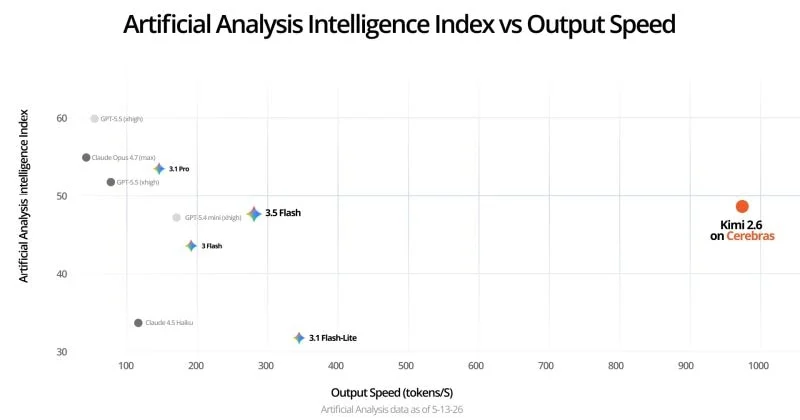
A wafer-scale chip company has just announced a record-breaking 981 tokens per second on its Kimi K2.6 AI model, making it 6.7 times faster than the previous GPU cloud leaders.
A New Champion Emerges
Cerebras Systems, known for their innovative chip architecture, has long claimed their design would disrupt traditional computing methods. Now, they’ve put their money where their mouth is, demonstrating a tangible performance boost in AI model processing speed.
The Kimi K2.6 model, developed by Moonshot AI, is a behemoth of a neural network – boasting 1 trillion parameters. This is a serious undertaking, requiring immense computational power. By achieving 981 tokens per second on this massive model, Cerebras has effectively upstaged the performance of GPU cloud-based infrastructure.
GPU Clouds in the Crosshairs
For years, GPU cloud providers like Amazon Web Services (AWS), Google Cloud, and Microsoft Azure have dominated the AI computing landscape. Their extensive networks of graphics processing units (GPUs) have enabled rapid AI model training and deployment. However, Cerebras’ results suggest their traditional approach may be about to be upended.
Cerebras’ Kimi K2.6 demo highlights the potential of wafer-scale computing to outperform GPU-based systems. Their customized architecture, which integrates numerous processing elements onto a single chip, appears to be a key factor in this success.
What this means
This breakthrough has significant implications for industries reliant on AI – including healthcare, finance, and autonomous vehicles. Companies can look forward to faster, more efficient computing, leading to improved AI model performance and lower operational costs. However, this may also trigger a paradigm shift in the way AI computing infrastructure is designed and deployed, as traditional GPU clouds face increased competition from innovative wafer-scale solutions.
Cerebras’ achievement serves as a testament to the innovative power of specialized silicon design. As the AI landscape continues to evolve, businesses and researchers alike would do well to keep an eye on this company’s progress – and the impact it may have on the future of AI computing.