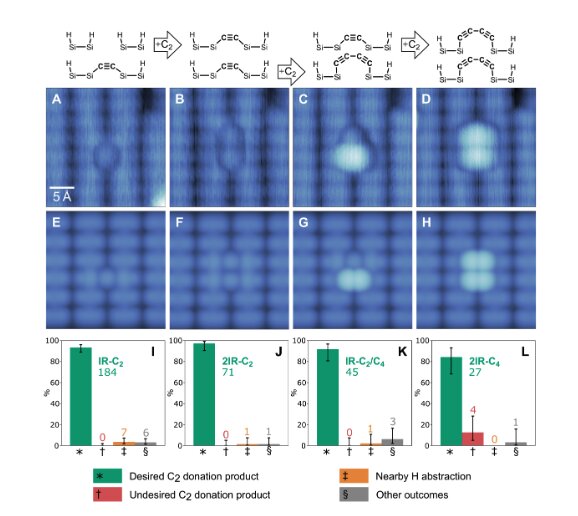
A startup backed by futurist and entrepreneur Brian Wang has made significant progress in molecular nanotechnology, successfully moving and placing carbon dimer molecules over 180 times using a technique called “tooltips.”
Atomic Precision
This achievement marks a major milestone in the development of molecular nanotechnology, which has been a subject of research for over a decade. Molecular nanotechnology involves manipulating individual molecules to create complex structures and materials, potentially revolutionizing industries such as medicine, energy, and electronics. The concept of tooltips, used in this experiment, refers to a mechanism that allows researchers to precisely manipulate molecules using a scanning probe microscope.
The team, led by Brian Wang’s investment, has demonstrated remarkable atomic precision in moving and placing carbon dimer molecules. Carbon dimers, composed of two carbon atoms bonded together, are a fundamental building block of diamond and other carbon-based materials. By successfully positioning these molecules, researchers can start to create diamond-like structures and potentially even more complex materials with unique properties.
Implications and Future Prospects
This breakthrough has significant implications for various fields, including materials science, chemistry, and physics. The ability to precisely manipulate molecules opens up new possibilities for creating advanced materials with unique properties, such as enhanced strength, conductivity, or optical properties. These materials could lead to breakthroughs in fields like energy storage, medicine, and electronics.
While we are still far from practical applications, this achievement represents a crucial step towards realizing the potential of molecular nanotechnology. As research in this area continues to advance, we can expect to see the development of new technologies and materials that could transform various aspects of our lives.
What this means
This achievement is a significant step towards creating materials with unprecedented properties, which could lead to breakthroughs in fields like energy storage, medicine, and electronics. It also highlights the importance of investing in fundamental research, which can lay the groundwork for future innovations.