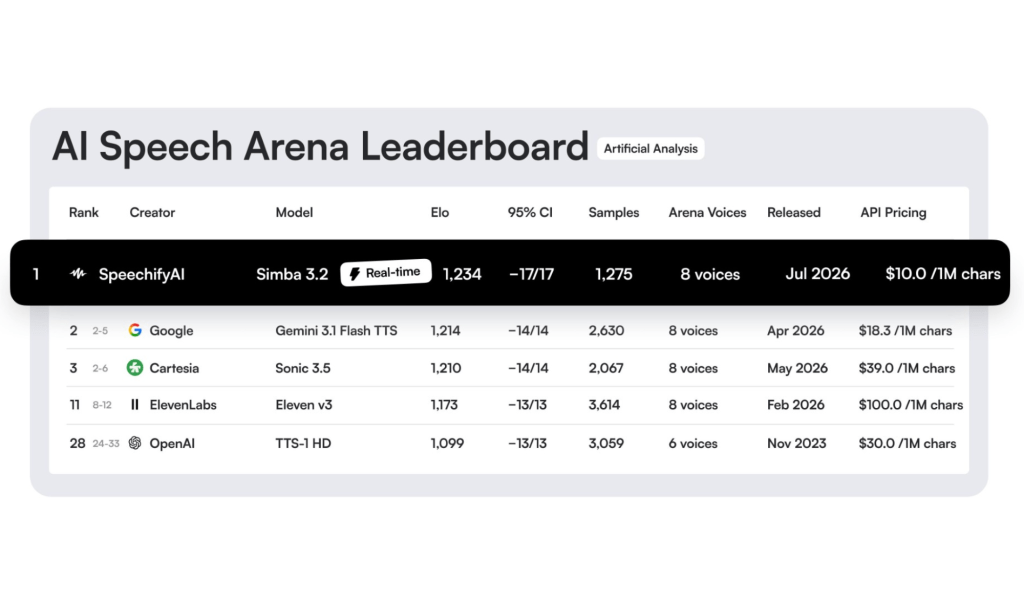
Speechify’s Simba 3.2 just took the top spot on a notoriously tough benchmark for voice AI, beating out industry heavyweights ElevenLabs and Cartesia.
The Voice AI Benchmark Challenge
Developed by independent testing firm, the benchmark pushed these AI models to their limits. It measures not just how quickly they can turn text into speech, but also how well they can replicate human-like voices, and – crucially – at what cost.
Simba 3.2, Speechify’s latest model, rose to the challenge, delivering high-quality text-to-speech (TTS) capabilities, fast turnaround times, and an unbeatable price. We’re talking tens of thousands of hours of training data, fine-tuned to produce remarkably lifelike voices.
What This Means
For entrepreneurs and developers, this is a major win. Suddenly, access to high-quality, enterprise-grade TTS capabilities isn’t reserved for deep-pocketed corporations. Speechify’s Simba 3.2 promises to democratize voice AI, making it easier and more affordable for small businesses, podcasters, and content creators to incorporate lifelike voices into their products and content.
The implications are significant. Imagine a world where your favorite podcasts, audiobooks, and voice assistants sound more natural, more engaging, and more like a human. We’re not just talking about incremental improvements; we’re talking about a fundamental shift in the way we experience digital content.
The Future of Voice AI
Speechify’s Simba 3.2 isn’t just a one-off achievement; it marks a significant milestone in the ongoing AI arms race. As the technology continues to advance, we can expect to see even more sophisticated models emerge, capable of replicating increasingly natural and nuanced human speech patterns.
For users, this means more immersive experiences, more engaging interactions, and – ultimately – a deeper connection with the digital world. It’s a future where AI-powered voices become a fundamental part of our daily lives, and where the boundaries between humans and machines begin to blur.