Supercool Water Cracked by AI: A Breakthrough in Understanding Earth’s Liquid Giant
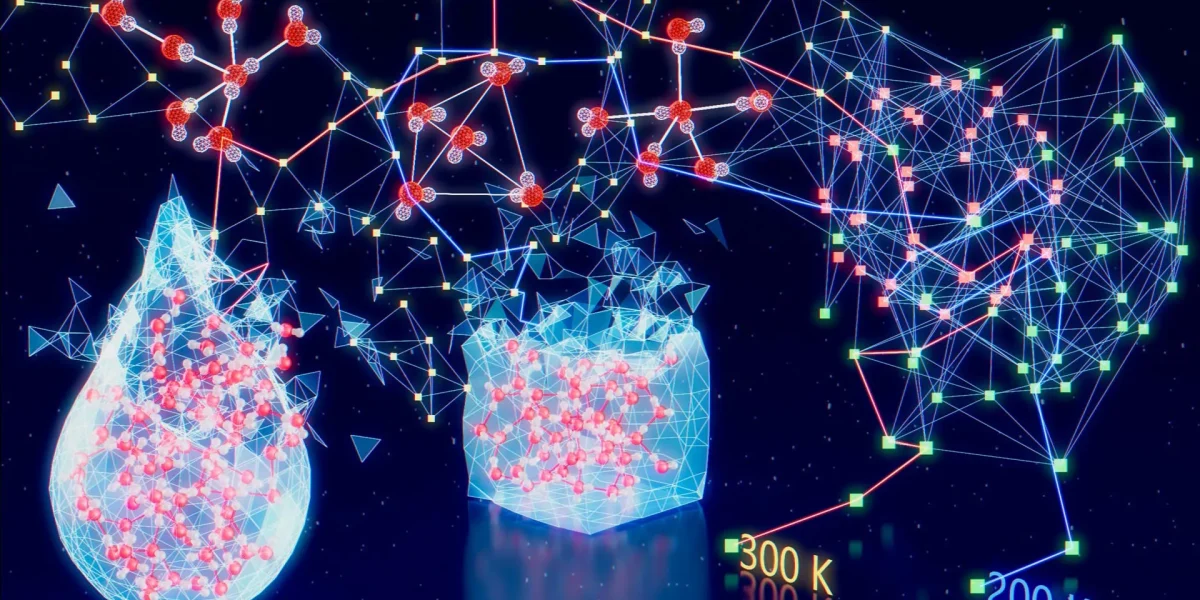
Scientists have finally cracked one of water’s biggest mysteries using an artificial intelligence model: its supercooled microscopic structure. Researchers at the University of Osaka used an AI model trained on complex computer simulations to compare and analyze the various ways of describing water’s unique behavior.
Water is a liquid like no other. It covers over 70% of our planet, yet its behavior is a far cry from most other substances. One of its most astonishing traits is that it expands instead of contracts when it freezes, making ice less dense than liquid water. This peculiarity has puzzled scientists for centuries.
Supercool water takes this odd behavior to new extremes. When cooled below its freezing point without actually freezing, it enters a state of suspended animation, its molecules moving in a way that is both ordered and disordered at the same time. This phase is known as a “metastable state.” But despite its importance in fields like climate science and materials engineering, researchers have struggled to describe the microscopic structure of supercooled water with precision.
How AI Cracked the Code
Researchers at the University of Osaka have managed to tackle this challenge head-on using a state-of-the-art AI model. By training the AI on a vast dataset of computer simulations, they were able to identify patterns and correlations in the behavior of supercooled water that had gone unnoticed before.
Through this AI-powered analysis, the team uncovered new insights into the arrangement of water molecules in the metastable state. Their findings suggest that the unique behavior of supercooled water is due to a delicate balance between hydrogen bonding and molecular correlations. This breakthrough has significant implications for our understanding of water’s role in the Earth’s climate system.
What This Means
The implications of this research are far-reaching, from improving our understanding of climate change to developing new materials with unique properties. By cracking the code of supercooled water, scientists have taken a crucial step toward unlocking the secrets of Earth’s most mysterious liquid.
As we continue to explore the mysteries of the natural world, AI will likely play an increasingly important role in uncovering new insights and solving long-standing puzzles. The collaboration between human researchers and AI models will undoubtedly yield groundbreaking advances in the years to come.