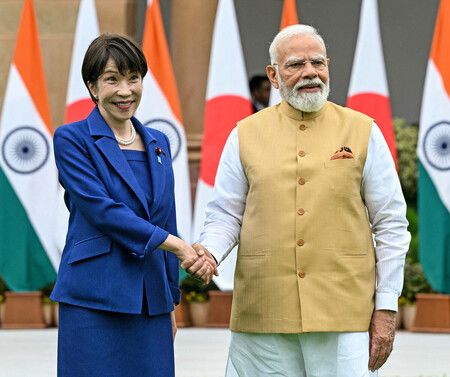
Japanese Prime Minister Sanae Takaichi’s surprise visit to India in early July 2026 has ignited a firecracker that may soon leave European alliances looking outdated. The whirlwind diplomatic tour marked the 15th India-Japan annual summit, with the two nations signing a whopping $22 billion in joint infrastructure projects.
A New Axis Emerges
The partnership between India and Japan has grown exponentially over the past few years, quietly forming an axis that could redefine global politics. At the heart of this alliance lies a shared vision to counterbalance the rise of China’s economic and military clout in Asia. As Tokyo and New Delhi look to fortify their strategic ties, the implications are far-reaching.
Japan’s investment in India’s infrastructure sector marks a significant shift in the country’s foreign policy. Traditionally reliant on the US and EU for diplomatic and economic backing, Japan’s growing dependence on India underscores a seismic shift in the country’s priorities. With China’s increasing aggression in the South China Sea, Japan sees India as a vital counterbalance to its expanding presence in the region.
A Strategic Imperative
India, meanwhile, stands to gain significantly from this partnership. As the country hurtles towards becoming the world’s third-largest economy by 2030, its need for infrastructure development has become a pressing strategic imperative. Japan’s investment in India’s infrastructure sector will not only fuel the country’s growth but also help it bridge the massive infrastructure gap that hobbles its development.
The partnership has also opened doors to technological cooperation, with both nations pledging to collaborate on cutting-edge technologies like advanced electronics, renewable energy, and artificial intelligence. This synergy will not only accelerate India’s digital transformation but also bolster Japan’s own AI prowess.
What This Means
What does this mean for Europe? It means that the old world order is slowly giving way to a new reality. The EU’s traditional relationships with Asia will need to be recalibrated to account for the rapidly strengthening ties between India and Japan. As the global balance of power shifts, Europe will be forced to reassess its alliances and forge new partnerships if it wants to remain relevant. The 2026 India-Japan summit has sent a clear message: Asia is rising, and Europe would do well to take note.