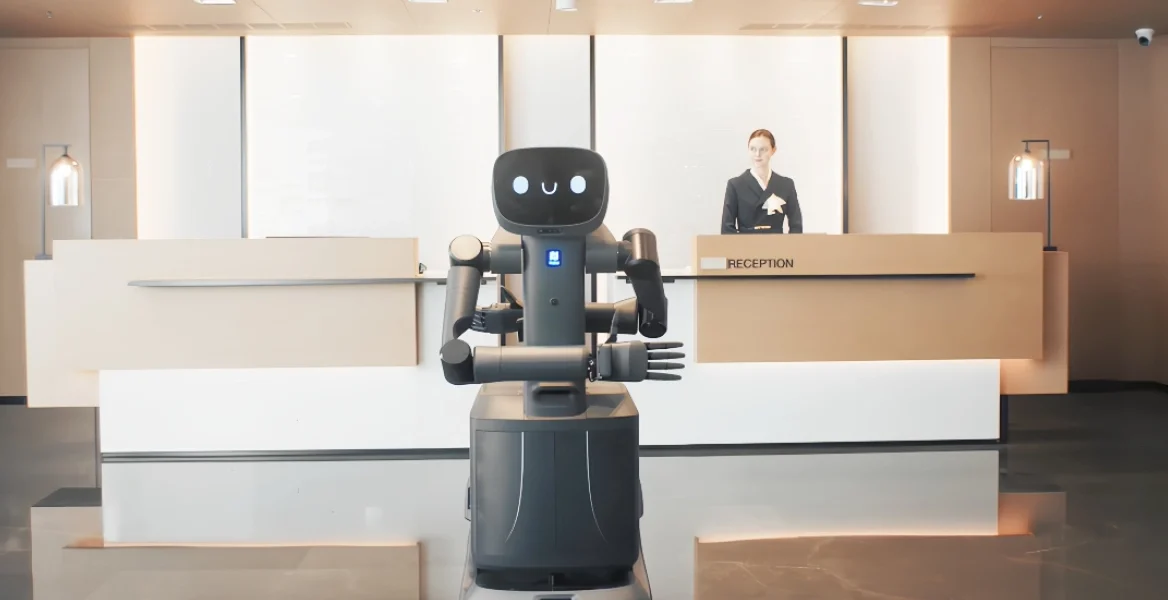
The Pudu Bot, a service robot designed by Chinese company Pudu Robotics, is poised to revolutionize the hotel experience in China with its debut as the world’s first fully robot-staffed hotel in 2027.
Rise of the Service Robots
The Pudu Bot has already gained traction in various sectors, including hospitals, offices, and restaurants, for its ability to efficiently and safely interact with guests. In its hotel iteration, the Pudu Bot will serve as a multi-functional robot, capable of handling tasks such as reception, room service, and luggage handling.
Hotel staff will no longer be required for these roles, marking a significant shift towards automation and AI-driven efficiency in the hospitality industry.
What this means
This development could pave the way for reduced labor costs, increased productivity, and enhanced customer experience. With robots handling routine and repetitive tasks, hotel staff can focus on providing personalized services and ensuring high-quality experiences for guests.
However, the impact on employment and labor rights in the hospitality sector remains to be seen. As robots take over more roles, there’s a growing concern about job displacement and the need for re-skilling and up-skilling of human staff.
Robotics and AI in Hospitality
The 2027 opening of the world’s first fully robot-staffed hotel marks a significant milestone in the adoption of robotics and AI in the hospitality industry. It could also serve as a testing ground for other innovative technologies, such as facial recognition, AI-powered concierge services, and smart room automation.
Chinese hotel chains and developers, such as the Pudu Robotics company behind the pioneering project, are likely to drive the adoption of these technologies in the hospitality sector, potentially leading to widespread adoption across the globe.
With its cutting-edge robots and AI-driven infrastructure, China is set to redefine the hotel experience and push the boundaries of what we expect from modern hospitality.