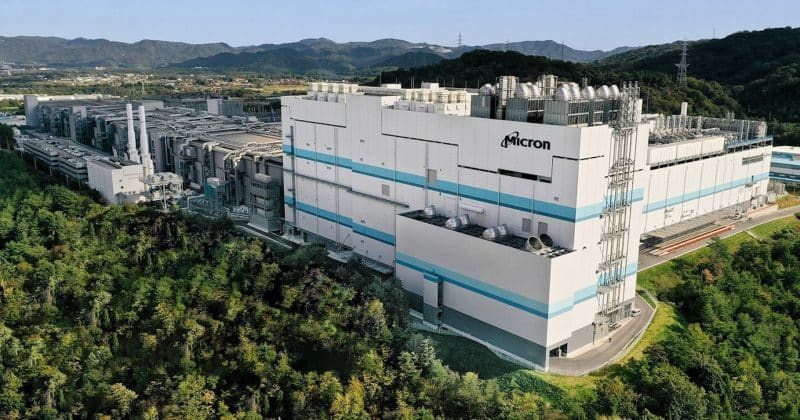
US memory giant Micron Technology is pouring $9.6 billion into its Hiroshima plant to produce high-bandwidth memory chips for artificial intelligence applications, breaking ground on a ¥1.5 trillion factory expansion in Japan.
A New Front in the Global Semiconductor War
Micron’s massive investment signals a strategic shift in global semiconductor manufacturing, potentially reshaping AI chip market dynamics. The move positions Micron to better compete with Asian chipmakers, who have traditionally dominated the high-end memory chip market.
As AI demand surges, companies are scrambling to secure a share of the rapidly growing market for specialized memory chips. These high-bandwidth memory chips enable faster data processing and storage, making them essential components in AI systems.
What this means
This $9.6 billion expansion will give Micron a significant edge in producing high-bandwidth memory chips, enabling the company to better serve AI-focused industries like cloud computing, data centers, and autonomous vehicles.
In practical terms, this means AI developers and businesses will have access to a more reliable and efficient supply of high-performance memory chips. This could accelerate AI innovation, driving advancements in areas like natural language processing, computer vision, and machine learning.
Global Chip Market Implications
Micron’s decision to expand in Japan also highlights the growing tension between global chipmakers. As the competition for AI chip market share intensifies, it remains to be seen how other major players, including Samsung, SK Hynix, and Intel, will respond to Micron’s move.
One thing is certain: the AI chip market is about to get a lot more interesting. With Micron’s massive investment, the stakes have been raised, and the outcome will have far-reaching implications for the global tech industry.