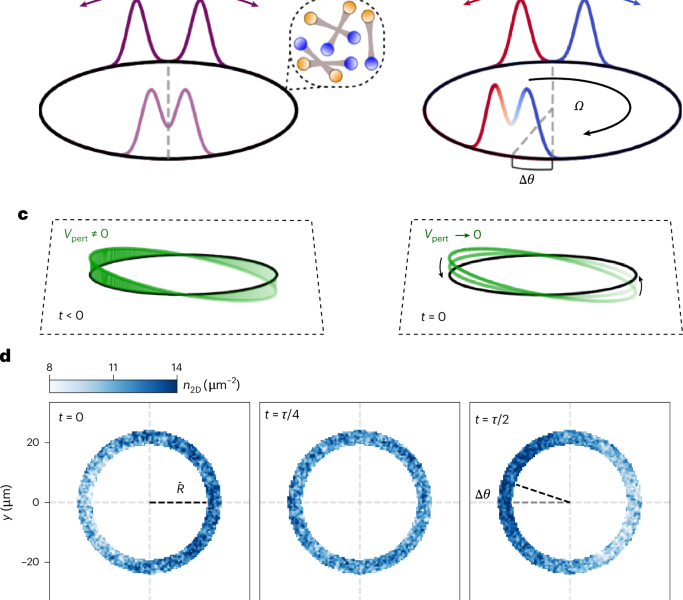
Physicists have just achieved a major breakthrough in understanding the behavior of superfluids, a state of matter that has captivated scientists for decades. They’ve successfully measured the angular momentum of rotating fermionic superfluids using a technique called Sagnac phonon interferometry.
The team used a setup that resembles a Sagnac interferometer, a device that’s typically used in optics to measure the rotation of a material. In this case, they applied the concept to measure the quantum of angular momentum per particle in a superfluid.
The experiment was conducted using a Sagnac-like phonon interferometer, which allowed researchers to measure the angular momentum of rotating fermionic superfluids across the BEC–BCS crossover. This crossover is a region where two different types of superfluids merge – a Bose-Einstein condensate (BEC) and a Bardeen-Cooper-Schrieffer (BCS) superconductor.
What is this achievement?
This breakthrough is significant because it provides direct measurements linking fermionic pairing to macroscopic superflow. To put it simply, it shows how the way individual particles interact with each other (fermionic pairing) affects the behavior of the superfluid as a whole.
The research has been published in a study titled “Angular momentum of rotating fermionic superfluids by Sagnac phonon interferometry.”
What this means
This achievement is an important step forward in understanding the behavior of superfluids, which could have significant implications for fields like quantum computing and materials science. While this breakthrough is primarily of interest to physicists, it could also inspire new technologies and innovations in the future.
What’s next?
Researchers are likely to build on this achievement by experimenting with different types of superfluids and investigating the properties of rotating superfluids in more detail. This could lead to new insights into the behavior of superfluids and potentially inspire new technologies and innovations.