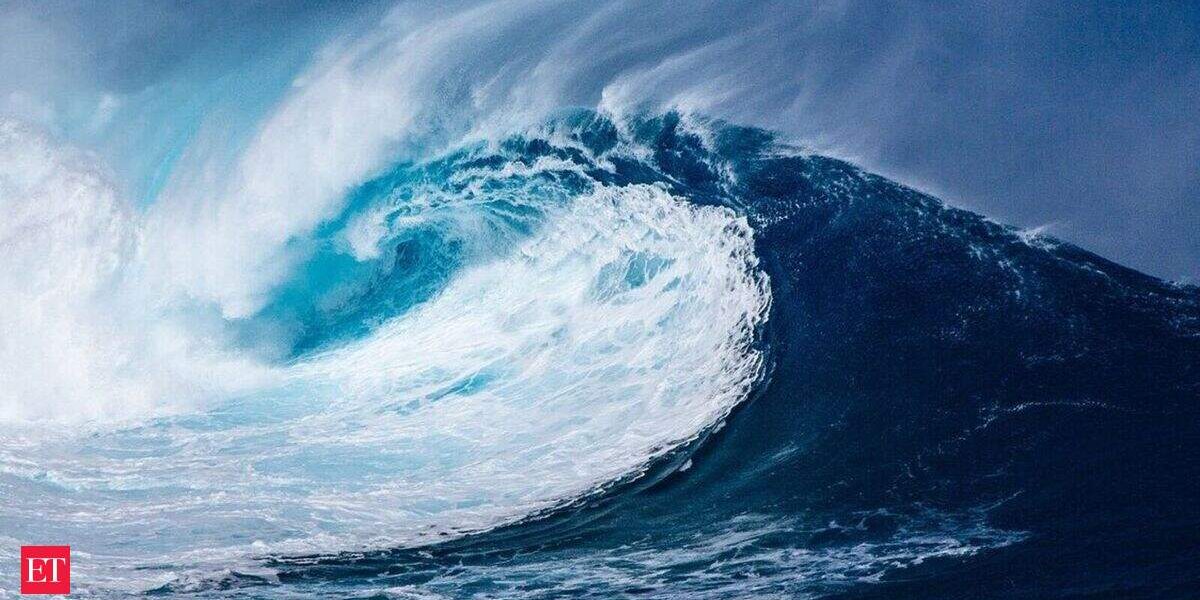
A 650-foot mega tsunami struck Greenland, sending shockwaves through the scientific community in September 2023.
The Mega Tsunami
The event was not caused by a typical earthquake or volcanic eruption, but instead by the collapse of a mountain in Greenland’s ice sheet, which triggered a massive wave. At 650 feet tall, the tsunami was an astonishing sight, and its impact was felt far beyond the event itself.
Satellite data from the European Space Agency’s (ESA) Sentinel-1 mission and NASA’s Gravity Recovery and Climate Experiment Follow-On (GRACE-FO) satellites provided the first clues about what happened. The Sentinel-1 data showed a massive displacement of water, equivalent to a 650-foot wave, while the GRACE-FO data revealed a significant shift in the Earth’s gravitational field.
The Mysterious Signal
But it was what happened after the tsunami that really caught scientists off guard. The event sent a mysterious signal through the Earth’s interior, detectable for nine consecutive days. Researchers from the University of Colorado Boulder used advanced seismic equipment to track the signal, which was unlike anything they’d seen before.
The signal, known as a “sine wave,” is typically associated with the Earth’s internal structure and the movement of tectonic plates. However, this was different. It was as if the Earth itself was creating a kind of “echo” of the tsunami, resonating with the energy released by the massive wave.
What This Means
The discovery of this mysterious signal has significant implications for our understanding of the Earth’s interior. It suggests that the Earth’s structure is more complex and dynamic than we previously thought, and that even massive external events like tsunamis can have a profound impact on the planet’s internal workings.
For scientists, this is a wake-up call to re-examine their understanding of the Earth’s behavior, particularly in regions like Greenland where massive ice sheets are melting at an alarming rate. As the planet continues to change, it’s clear that we need to stay vigilant and adapt our understanding to new evidence.
What this means in practical terms is that scientists will need to incorporate this new understanding into their modeling and forecasting of natural disasters like tsunamis and earthquakes. By doing so, they can better prepare communities and mitigate the impact of these events.