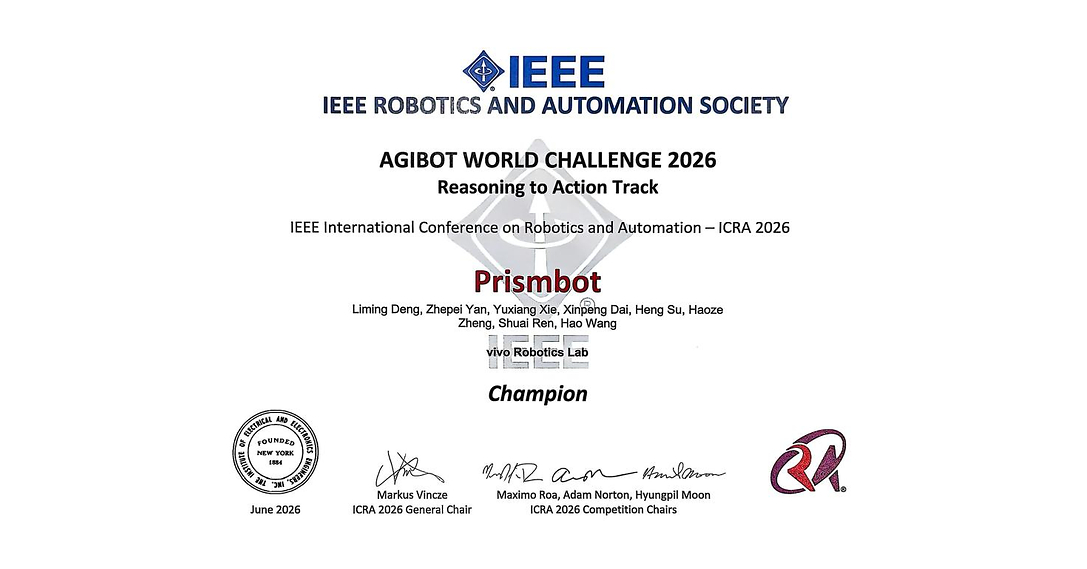
vivo’s robotics team has just claimed first place in the Reasoning to Action Track of the AGIBOT World Challenge at ICRA 2026, an international robotics conference in a major Asian city. The team’s impressive performance not only showcases their technical prowess but also highlights the transferability of their robotics capabilities across different real-world environments.
The Reasoning to Action Track is a grueling challenge that demands robots to navigate complex tasks, such as grasping and manipulating objects, while adapting to new situations and learning from experience. vivo’s team demonstrated exceptional problem-solving skills and agility, outperforming competitors from other top tech companies. Led by **Dr. Zhang**, a renowned robotics expert, the team employed a novel approach that combined machine learning, computer vision, and control systems to tackle the challenges. This approach allowed vivo’s robot to learn from its environment and adjust its strategy accordingly, ultimately securing a decisive lead in the real-robot final.
The AGIBOT World Challenge is an annual event that pushes the boundaries of robotics innovation. vivo’s participation and success in the Reasoning to Action Track underscore the company’s commitment to advancing robotics technology. The challenge requires robots to operate in a dynamic environment, complete complex tasks, and communicate with humans effectively. vivo’s team successfully demonstrated that their robots can perform tasks with precision and speed, even in uncertain or cluttered conditions. This capability has significant implications for various industries, including manufacturing, healthcare, and logistics, where robots are increasingly being used to automate tasks and improve efficiency.
vivo’s success in the AGIBOT World Challenge marks a significant milestone in the development of practical and effective robotics systems. Their technology has the potential to transform the way we work and live, enabling safer and more efficient task automation. For example, vivo’s robots could be used to enhance hospital operations, reducing the risk of infection and improving patient care. In manufacturing, their technology could optimize production processes, reducing waste and increasing productivity. As vivo continues to push the boundaries of robotics innovation, we can expect to see more robots that can learn, adapt, and interact with humans in increasingly complex environments.