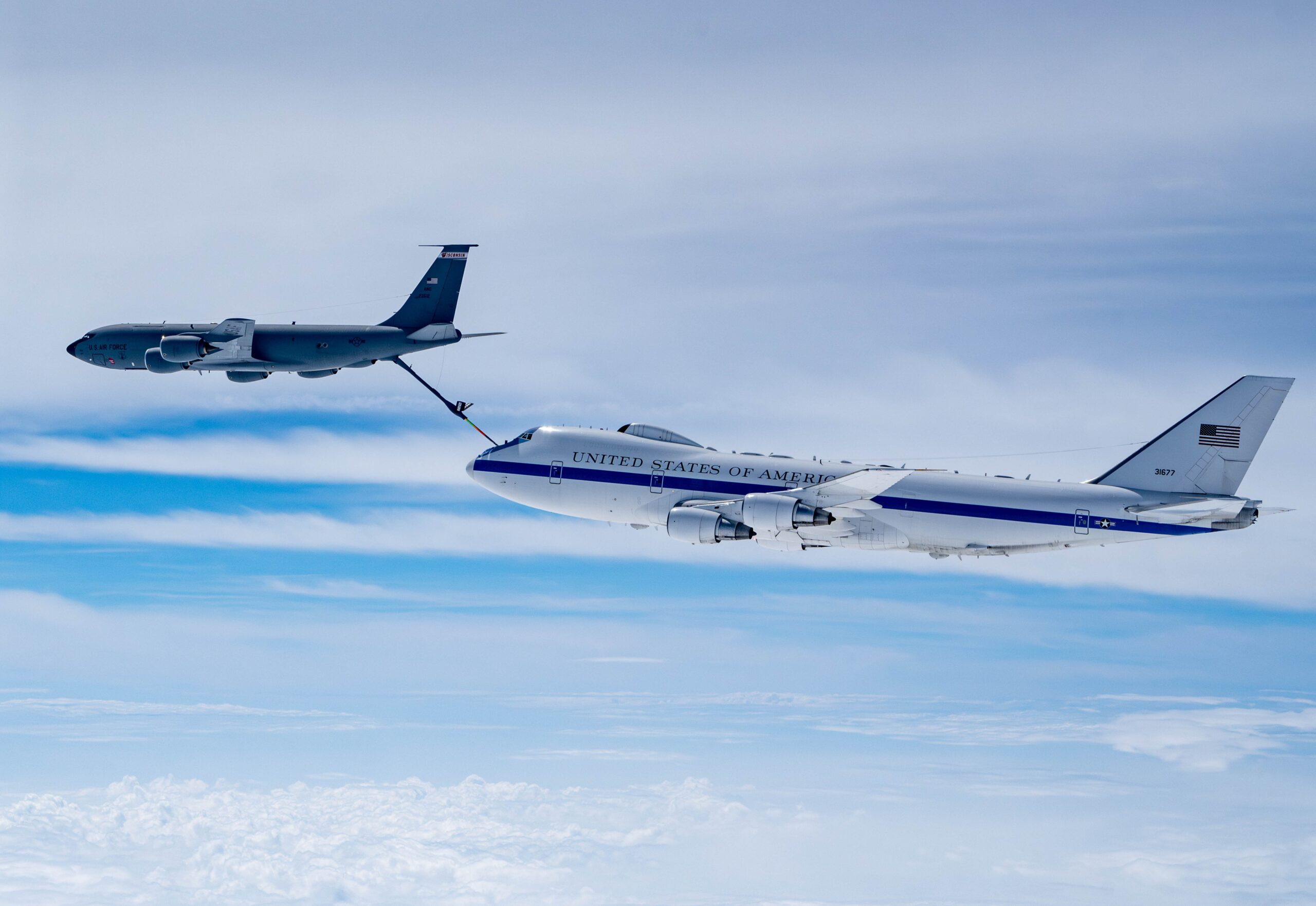
L3Harris Tapped for E-4C Communications Support
L3Harris Technologies has recently been selected to provide assured communications support for the U.S. Air Force’s E-4C fleet, marking a significant collaboration as part of the Survivable Airborne Operations Center (SAOC) program. This selection underscores L3Harris’s pivotal role in one of the military’s most sensitive command-and-control missions.
Partnership with SNC and Collins Aerospace
According to a press release, L3Harris Technologies is set to operate as a subcontractor within the SAOC initiative, which is led by Sierra Nevada Corporation (SNC). The engineering and manufacturing development work awarded to L3Harris will extend over a five-year period, executed through Collins Aerospace, a business unit of RTX.
The Strategic Importance of the SAOC Program
The SAOC program aims to replace the existing E-4B “Nightwatch” aircraft with the E-4C. This replacement is critical to ensuring that the U.S. Air Force maintains an airborne command post capable of functioning during national emergencies and in high-stakes conflicts. The E-4C is expected to support senior civilian and military leadership with secure and resilient communications, even in contested environments.
Role of L3Harris in Communication Suite Integration
As a part of the SNC-led team, L3Harris’s responsibilities include the integration of advanced communication suites for the E-4C fleet. The company plans to leverage its latest resilient communications technologies to enhance this platform. With over 15 years of experience supporting the E-4C’s predecessor, the E-4B, L3Harris is well-positioned to implement upgraded systems that can operate under challenging conditions where traditional communications may be unreliable.
Innovative Technology for Enhanced Mission Execution
Lauren Barnes, president of Broadband Communications Systems at L3Harris, emphasized the company’s commitment to providing upgraded and state-of-the-art capabilities for the E-4C fleet. She stated, “Our open-system technology and vast portfolio of resilient waveforms will support seamless software upgrades and longevity for this vital program well into the future.”
The E-4C as a Central Node in National Command Authority Communications
The E-4C, operated by the U.S. Air Force, is envisioned to act as a central node for national command authority communications. It is designed to link various airborne, ground, and space-based systems. In times of crisis, when access to fixed command centers might be degraded or denied, the E-4C must remain operational and effective.
L3Harris’s Broader Involvement in Airborne and Electronic Warfare Programs
L3Harris’s dedication to the SAOC effort exemplifies its extensive involvement in airborne and electronic warfare programs throughout the Department of Defense. The company’s portfolio includes significant contributions to projects like the Advanced Battle Management System and the Next-Generation Jammer – Low Band program. Additionally, L3Harris delivers vital electronic warfare and communications technology for multiple Air Force platforms, including the F-16 Falcon, EA-37B Compass Call, and B-2 Spirit.
Maintaining Connectivity and Situational Awareness
The focus of these programs is on ensuring connectivity, survivability, and situational awareness in environments where conventional communications may be significantly challenged. As the landscape of warfare evolves, the capabilities provided by L3Harris are essential in modernizing the U.S. Air Force’s communication capabilities.
Looking Ahead: A Secure Communications Future
The integration of L3Harris’s advanced technologies and its commitment to enhancing the E-4C fleet is a testament to the company’s strategic approach to modern defense challenges. By supporting the SAOC program, L3Harris not only strengthens the Air Force’s operational capabilities but also reinforces national security in an increasingly complex battlefield landscape.
In conclusion, L3Harris Technologies is poised to play a crucial role in supporting the U.S. Air Force’s E-4C fleet, ensuring that communications remain robust and reliable in the face of adversity. As threats evolve and become more sophisticated, the advancements brought forth by L3Harris will be instrumental in maintaining the effectiveness of military operations both in the air and on the ground.
Be First to Comment